
Nose & Eyebrow Trimmer Blades: OEM Specs, MOQ & Cost Guide
Rotary nose trimmer heads and eyebrow blade sets explained by a manufacturer: 0.02-0.05mm cutter clearance, EN 1811 nickel limits, IPX7 sealing, 100k-cycle life, 1,000 MOQ and $0.35-1.60 FOB. Get a quote.
Quick answer: Precision facial trimmer blades come in two architectures — a rotary nose trimmer head (slotted outer guard plus a rotating dual-edge inner cutter) and a reciprocating eyebrow or detail blade (fine-tooth cutter oscillating against a comb). The spec that decides whether the device cuts or pulls is the clearance between cutter and guard: 0.02-0.05mm. Above roughly 0.08mm the hair folds into the gap instead of shearing, which is what a customer describes as "it pulls". Expect 1,000-3,000 piece MOQ, $800-4,000 tooling, 35-60 day lead time, and $0.35-1.60 FOB China per blade or head depending on type and volume.
We manufacture precision small blades in Haining, Zhejiang alongside our clipper and razor lines. These parts are the least glamorous item in a men's grooming kit and the single most common source of one-star reviews, because the tolerances are tighter than the clipper blades sitting next to them on the same bench. This guide is written for the buyer specifying a nose, ear or eyebrow trimmer programme.
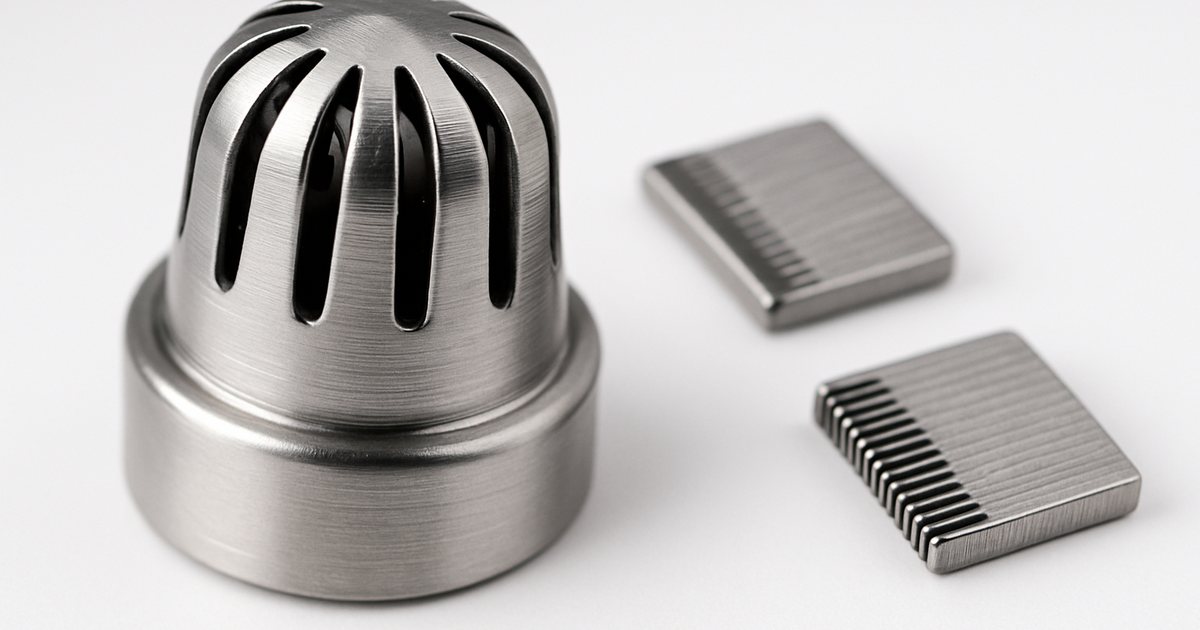
Two Architectures, Two Completely Different Cost Structures
| Type | How it cuts | Used for | Critical dimension | FOB China |
|---|---|---|---|---|
| Rotary head | Inner cutter spins inside a slotted dome; hair enters slot and is sheared | Nose, ear | Cutter-to-guard clearance 0.02-0.05mm | $0.80-1.60 |
| Reciprocating fine-tooth | Cutter oscillates laterally against a fixed comb | Eyebrow, sideburn, detail | Tooth pitch 0.6-1.0mm, gap ≤0.03mm | $0.35-0.90 |
| Foil head | Oscillating cutter under a thin perforated foil | Finishing, body, sensitive skin | Foil thickness 0.04-0.06mm | $0.90-2.20 |
| Micro T-blade | Exposed narrow cutting edge, reciprocating | Outlines, beard edges | Edge exposure 0.1-0.3mm | $0.60-1.40 |
Rotary heads cost more because they are an assembly, not a part: outer guard, inner cutter, drive coupling, and often a bearing or bushing, all of which must be built to a stack-up tolerance that lands inside 0.05mm. The reciprocating blade families are closer in production terms to a scaled-down T-blade or U-blade.
The Rotary Nose Trimmer Head, In Detail
A nose trimmer has one job that is harder than it looks: cut hair that is anchored in soft, mobile tissue, without ever presenting an edge to that tissue.
The outer guard does the safety work. Its slots are sized so hair passes freely but skin cannot fold in — typically 0.8-1.2mm wide with a fully radiused, dead-blunt outer surface. Behind it, the inner cutter carries two or four ground edges and rotates at roughly 5,000-9,000 rpm. Hair enters a slot, meets a passing edge, and is sheared against the inside face of the guard.
Three dimensions determine whether that shearing action works:
| Dimension | Target | What happens if it drifts |
|---|---|---|
| Cutter-to-guard clearance | 0.02-0.05mm | Above 0.08mm hair folds instead of shearing — the classic "it pulls" complaint. Below 0.015mm the head binds and drains the battery |
| Guard slot width | 0.8-1.2mm | Too narrow and coarse hair will not enter; too wide and the design becomes a skin-nick risk |
| Cutter edge angle | 28-35° | Steeper cuts cleaner but chips; shallower wears blunt within weeks of daily use |
| Concentricity, cutter to guard | ≤0.02mm TIR | Eccentric running gives intermittent cutting and audible rumble — perceived as "cheap" |
| Guard outer edge radius | ≥0.15mm, fully deburred | Any residual burr becomes a nasal laceration and a product-liability claim |
Materials and Skin-Contact Compliance
These blades sit against the inside of the nose or against the eyelid margin, which puts them in a stricter compliance category than a clipper blade that touches the scalp.
| Grade | Typical hardness | Corrosion resistance | Best use |
|---|---|---|---|
| 420J2 | HRC 50-54 | Good | Volume guards and combs; easy to form, cheapest |
| 440C | HRC 58-62 | Good | Inner cutters and fine-tooth eyebrow blades — best edge retention |
| 304 austenitic | HRC <30 | Excellent | Non-cutting guards and housings only — will not hold an edge |
| Titanium-nitride coated 440C | Surface HV 2,000+ | Excellent | Premium tier; see our TiN coating analysis |
Two compliance items belong in the PO, not in a post-shipment scramble:
- Nickel release. Items in prolonged contact with skin fall under REACH Annex XVII entry 27, tested to EN 1811, with a release limit of 0.5 µg/cm²/week for general skin contact. Martensitic stainless normally passes comfortably, but ask for the report rather than assuming — plated decorative parts are where this fails.
- Appliance safety. The finished trimmer is covered by IEC/EN 60335-2-8 (shavers, hair clippers and similar appliances). Your blade supplier's material and construction data feed that file; they do not replace it.
For a US-market programme add a RoHS and California Prop 65 statement covering the blade, the coating and any lubricant supplied with it.
Waterproofing: What "Washable" Costs You
Nearly every nose trimmer now claims washable operation, and it is the most common place a specification quietly falls apart. Rinsing under a tap is not IPX7 immersion, and the two require different constructions.
| Claim | Test | Head construction needed | Cost adder |
|---|---|---|---|
| "Rinse the head under a tap" | IPX4 splash | Detachable head, drainage path, corrosion-resistant cutter | Baseline |
| "Fully washable" | IPX6 jet | Shaft seal at the drive coupling | +$0.10-0.25 |
| "Use in the shower" | IPX7 immersion 1m/30min | Sealed drive, O-ring, sealed battery compartment, tested per unit | +$0.35-0.80 |
The failure mode when a supplier ships an IPX4 construction against an IPX7 claim is not immediate. Water wicks along the drive shaft, sits in the bushing, and the head seizes at week six — well past your inspection and right inside your return window. If the packaging says shower-safe, the drive seal has to be in the drawing.
Quality Control Plan
These are small, cheap parts. The temptation is to inspect them like fasteners. Do not.
- Clearance verification, 5 pcs per lot. Feeler gauge or vision measurement of cutter-to-guard gap. This is the number that drives returns.
- Hair-bundle cut test, AQL 1.0 major. The 20-hair test above, on assembled heads.
- Cycle life, 3 pcs per production run. 100,000 cycles minimum for a mid-tier device, 250,000 for premium, with clearance re-measured afterwards. Wear shows up as clearance growth long before it shows as a blunt edge.
- Burr and edge-radius inspection at 30x, 100% on guards. A burr on a nose trimmer guard is a safety defect, not a cosmetic one.
- Salt spray per ASTM B117, 24-48 hours. Catches the substitution of an uncoated or incorrectly passivated batch — the most common quiet material swap in this category.
- Torque-to-turn on assembled heads. A simple go/no-go on binding, which also predicts battery runtime complaints.
MOQ, Tooling, Lead Time and Pricing
| Scenario | MOQ | Tooling | Lead time | FOB / pc |
|---|---|---|---|---|
| Existing rotary head, your packaging | 1,000 pcs | None | 25-35 days | $1.10-1.60 |
| Existing eyebrow blade, your packaging | 1,000 pcs | None | 20-30 days | $0.55-0.90 |
| Custom guard profile or drive interface | 3,000-5,000 pcs | $800-2,500 | 40-55 days | $0.80-1.30 |
| Full custom head, new stamping + assembly fixture | 10,000 pcs | $2,500-4,000 | 50-60 days | $0.70-1.10 |
| Repeat order, established SKU, 50,000+ pcs | 5,000 pcs | Amortised | 20-25 days | $0.35-0.75 |
A useful planning figure: on a finished nose trimmer retailing at $15-25, the cutting head is 6-11% of FOB cost and is responsible for the large majority of functional returns. Saving $0.20 on the head is the worst $0.20 in the bill of materials to save.
The Four Complaints That Come Back From the Field
- "It pulls." Almost always clearance above 0.08mm, occasionally a blunted cutter from a shallow edge angle. Fixable in the drawing, not in customer service.
- "It stopped after a few weeks." Water ingress at the drive coupling on a head built to a splash spec but sold on an immersion claim.
- "It scratched inside my nose." A burr or an insufficient edge radius on the guard. This is why guard inspection is 100%, not sampled.
- "The battery died fast." Frequently not the battery. A head running at 0.015mm clearance or with an eccentric cutter draws measurably more current than a correctly built one.
Working With Us
Our precision small blade line covers rotary nose trimmer heads such as the SX-618 dual-edge head, and fine-tooth eyebrow blades including Model 513 and the wider-cut Model 515. We run these on the same grinding and inspection equipment as our professional hair blades, which is why we can hold clipper-grade tolerances on parts this small. MOQ from 1,000 pieces, custom guard and drive interfaces welcome. See OEM & custom manufacturing, our private label programme, or send a drawing for a quote.
Related Guides
- Trimmer Blade Types: T-Blade vs U-Blade vs Foil — the larger barber trimmer families.
- Private Label Clipper Blades & Razors — branding, packaging and programme structure.
- Wholesale Hair Clippers Sourcing Guide — the complete device, motor and battery side.
- Clipper Blade Steel Grades Explained — 420 vs 440A vs 440C in plain terms.
- How to Source OEM Blades from China — payment terms, audits and shipping.
Frequently Asked Questions
Why does my nose trimmer pull hair instead of cutting it?
In nearly every case the clearance between the rotating inner cutter and the slotted outer guard has drifted above about 0.08mm. At that gap the hair folds into the space rather than being sheared against the guard wall. The working target is 0.02-0.05mm. A blunted cutter edge, usually from an edge angle ground shallower than 28°, produces the same symptom more gradually.
What is the MOQ for OEM nose and eyebrow trimmer blades?
1,000 pieces for an existing rotary head or eyebrow blade in your packaging, 3,000-5,000 pieces for a custom guard profile or drive interface with $800-2,500 tooling, and 10,000 pieces for a fully custom head requiring new stamping tools and an assembly fixture. Repeat orders on an established SKU drop to 5,000 pieces.
How much do trimmer blades and rotary heads cost from a factory?
FOB China, roughly $0.80-1.60 per rotary nose trimmer head, $0.35-0.90 per reciprocating eyebrow or detail blade, $0.90-2.20 per foil head and $0.60-1.40 per micro T-blade. On a finished trimmer retailing at $15-25 the cutting head is only 6-11% of FOB cost, but it drives most functional returns.
What steel should be used for facial trimmer blades?
440C at HRC 58-62 for inner cutters and fine-tooth eyebrow blades, because edge retention is what the user perceives as quality. 420J2 at HRC 50-54 is adequate and cheaper for guards and combs, which do not cut. Use 304 only for non-cutting housings — it cannot hold an edge. Titanium-nitride coating on 440C is a genuine premium-tier upgrade rather than a cosmetic one.
Do nose trimmer blades need nickel-release testing?
Yes, if the product is sold in the EU or UK. Items in prolonged skin contact fall under REACH Annex XVII entry 27, tested to EN 1811 with a limit of 0.5 µg/cm²/week. Martensitic stainless steel normally passes, but request the test report at PO stage rather than assuming — decorative plated components are where this requirement usually fails.
What does IPX7 actually require on a washable nose trimmer?
IPX7 means 30 minutes at 1 metre immersion, which needs a sealed drive coupling, an O-ring and a sealed battery compartment — about $0.35-0.80 per unit above a splash-resistant build. Rinsing the detachable head under a tap is only IPX4. Selling an IPX4 construction on a shower-safe claim typically fails at around week six as water wicks along the drive shaft and seizes the bushing.
How long should a nose trimmer head last?
Specify at least 100,000 cycles for a mid-tier device and 250,000 for a premium one, with cutter-to-guard clearance re-measured after the test. Wear appears as clearance growth well before the edge itself goes blunt, so a cycle test that only checks "does it still run" will pass heads that already pull hair.