
Dog Grooming Clipper Blades by Coat Type: Complete Selection Guide | SUMTHIN
Choose the right dog grooming clipper blade for every coat type — smooth, double, curly, wire, and long. Blade number → cut length mapping table with breed examples. By a clipper blade manufacturer.
Choosing the wrong dog grooming clipper blade for a coat type is the single fastest way to overheat your clipper, leave track marks, and turn a routine groom into a stressful experience — for both the groomer and the dog. A #7F finish-cut blade glides through a Poodle's curly coat beautifully, but the same blade bogs down within 30 seconds on a Husky's dense double coat. A skip-tooth #5 clears a Golden Retriever's undercoat in half the time, but leaves rough lines on a Maltese that a client will notice immediately.
We manufacture over 250,000 A5 detachable blades per day at our factory in Haining, Zhejiang. Our production and groomer feedback data covers every major coat type across hundreds of breeds. This guide maps each coat category to specific blade numbers, tooth geometries, and cutting techniques so you can pick the right blade before you power on — not halfway through the groom.
If you need a quick reference for blade sizes and cut lengths, start with our complete clipper blade size chart. For blade material differences, see our ceramic vs steel comparison.
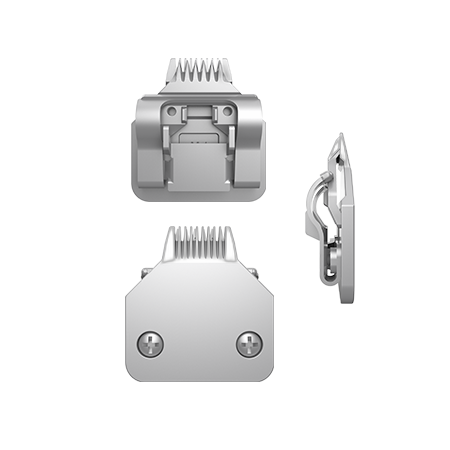
Why Coat Type Determines Your Blade Choice
Dog coats vary in five key properties that directly affect blade performance:
- Density: How many hairs per square centimetre. Dense coats (Huskies, Pomeranians) generate more friction and heat against the blade teeth.
- Texture: Coarse hair wears blade edges faster than fine hair. Wire-coated terriers have the most abrasive hair; silky breeds like Yorkshire Terriers have the least.
- Curl pattern: Curly and corded coats wrap around teeth differently than straight coats. Tight curls require closely spaced teeth to feed evenly.
- Layer count: Single-coated breeds (Poodles, Maltese) have one layer. Double-coated breeds (Samoyeds, German Shepherds) have a dense undercoat beneath a longer topcoat — effectively doubling the hair volume the blade must process.
- Mat tendency: Breeds that mat easily (Doodles, Cockapoos, long-haired breeds with poor home maintenance) often need a different blade strategy than the same breed in well-maintained coat.
Matching these properties to the correct blade number and tooth geometry is the difference between a 40-minute groom and an 80-minute struggle. Let us break it down by coat type.
Coat Type to Blade Number Mapping Table
This table covers the five primary coat categories recognized by professional groomers. Blade numbers follow the A5 detachable system. For breed-specific blade sizing with cut lengths in millimetres, see our full size chart.
| Coat Type | Recommended Blade(s) | Cut Length | Tooth Type | Example Breeds |
|---|---|---|---|---|
| Smooth / Short Coat | #7F, #10 | 3.2mm, 1.5mm | Finish-cut | Boxer, Beagle, Dalmatian, Doberman, Greyhound, Bull Terrier |
| Double Coat (Dense) | #5 skip, #7 skip, #4F | 6.3mm, 3.2mm, 9.5mm | Skip-tooth (rough cut), then Finish-cut (final pass) | Husky, German Shepherd, Golden Retriever, Samoyed, Pomeranian, Corgi |
| Curly / Wool Coat | #4F, #5F, #7F, #10, #15 | 9.5mm, 6.3mm, 3.2mm, 1.5mm, 1.2mm | Finish-cut only | Poodle, Bichon Frise, Lagotto Romagnolo, Portuguese Water Dog, Goldendoodle |
| Wire / Broken Coat | #5F, #7F, #10 | 6.3mm, 3.2mm, 1.5mm | Finish-cut | Wire Fox Terrier, Schnauzer, Airedale, Wirehaired Dachshund, Irish Wolfhound |
| Long / Silky Coat | #3F, #4F, #5F + guide combs | 13mm, 9.5mm, 6.3mm (+ combs to 25mm+) | Finish-cut | Maltese, Yorkshire Terrier, Shih Tzu, Afghan Hound, Cavalier King Charles |
Smooth / Short Coat Breeds
Smooth-coated dogs — Boxers, Beagles, Dalmatians, Dobermans, Greyhounds — have short, flat-lying hair that rarely needs clipping for length. The most common reason to clip a smooth coat is sanitary trimming, surgical prep, or addressing skin conditions under veterinary direction.
Blade strategy: Use a #7F (3.2mm) for general body clean-up and sanitary areas, or a #10 (1.5mm) for close surgical prep and belly/groin trimming. Finish-cut blades work perfectly here because there is no dense undercoat to clog the closely spaced teeth. Skip-tooth blades are unnecessary and actually increase the risk of nicking the thin skin common to short-coated breeds.
Heat management: Short-coated breeds have less hair insulation between blade and skin. The blade reaches the skin faster, making heat a concern even at moderate use. Consider ceramic blades, which generate approximately 75% less heat than steel — a meaningful difference when working close to skin on a sensitive Greyhound or Boxer.
Double Coat (Dense Undercoat) Breeds
Double-coated breeds — Huskies, German Shepherds, Golden Retrievers, Samoyeds, Pomeranians, Corgis, Australian Shepherds — present the biggest challenge in grooming. The dense undercoat can be 5-10x thicker than the topcoat, and it is the primary cause of blade overheating, motor stalling, and premature dulling.
Blade strategy (two-pass method):
- First pass — skip-tooth #5 or #7: A skip-tooth blade's wide tooth gaps allow the dense undercoat to feed through without packing between the teeth. This rough cut removes the bulk of the coat volume. Expect to stop every 3-5 minutes to brush hair out of the blade and spray coolant.
- Second pass — finish-cut #4F or #5F: After the bulk is removed, switch to a finish-cut blade for a smooth final surface. The coat is now thin enough that the closely spaced teeth will not clog.
Wide blades recommended: For large double-coated breeds (Golden Retrievers, Samoyeds, Great Pyrenees), consider wide blades (#5W, #7W) which cover 50% more coat per pass. Our factory data shows wide blades reduce total groom time by 25-35% on breeds over 25kg. See our complete blade types guide for detailed wide blade specifications.
Important note on double-coat grooming controversy: Many groomers and breed enthusiasts argue that double-coated breeds should never be clipped because it can damage the coat's natural temperature regulation. This guide does not take a position on that debate — we provide blade recommendations for groomers who do clip double coats, whether by owner request, medical necessity, or matting removal. Always discuss coat management with the pet owner before clipping.
Curly / Wool Coat Breeds
Curly-coated breeds — Standard Poodles, Miniature Poodles, Bichon Frises, Lagotto Romagnolos, Portuguese Water Dogs, and the rapidly growing Doodle category (Goldendoodles, Labradoodles, Bernedoodles) — have continuously growing hair that must be clipped regularly to prevent matting.
Blade strategy: Finish-cut blades exclusively. Curly coats feed into closely spaced teeth predictably and produce an even, polished result. The specific blade number depends on the clip style:
| Clip Style | Blade | Cut Length | Notes |
|---|---|---|---|
| Poodle face & feet | #10, #15 | 1.5mm, 1.2mm | Clean, close trim. #15 for competition, #10 for pet grooms |
| Body (short clip) | #5F, #7F | 6.3mm, 3.2mm | Most common pet Poodle body length |
| Body (longer clip) | #4F + guard combs | 9.5mm–25mm | Teddy bear cuts, Doodle full-body clips |
| Sanitary areas | #10 | 1.5mm | Standard for all breeds |
| Matted Doodle (rescue cut) | #7F or #10 | 3.2mm, 1.5mm | Slide blade under mat. Never force through mats with a longer blade |
The Doodle factor: Doodle breeds (Goldendoodle, Labradoodle, etc.) now account for an estimated 15-20% of grooming appointments in North America. Their coats are notoriously inconsistent — some individuals have tight Poodle curls, others have flat Retriever waves, and many have a mixed texture that varies across the body. For these dogs, bring multiple blade sizes to the table and test a small patch before committing to a full-body blade choice.
Best blade material for curly coats: Ceramic moving blades outperform steel on curly coats because Poodle and Doodle grooms are the longest appointments (60-120 minutes). A steel blade that runs hot after 15-20 minutes of continuous use needs coolant spray every few minutes. A ceramic blade stays cool 3-4x longer, reducing interruptions. Read the full ceramic vs steel breakdown for detailed performance data.
Wire / Broken Coat Breeds
Wire-coated breeds — Wire Fox Terriers, Standard Schnauzers, Miniature Schnauzers, Airedales, Wirehaired Dachshunds, Wirehaired Pointing Griffons, and Irish Wolfhounds — have coarse, bristly outer coats designed to protect against brush and bramble. This coat texture is the most abrasive on clipper blades.
Blade strategy: Finish-cut #5F (6.3mm) or #7F (3.2mm) for body work, #10 (1.5mm) for ears, throat, and sanitary areas. Skip-tooth blades are unnecessary because wire coats lack the dense undercoat volume that requires wide tooth spacing. The hair is coarse but not voluminous.
Edge wear warning: Wire coats dull blades approximately 2x faster than smooth or silky coats. Our factory testing shows that a standard steel blade grooming wire-coated breeds needs sharpening after 80-100 uses, compared to 150-200 uses on curly or silky coats. If you groom Schnauzers and terriers regularly, budget for more frequent sharpening or invest in ceramic blades which last 3-5x longer between sharpening. See our blade size chart for all available sizes.
Hand-stripping vs clipping: Show groomers for wire-coated breeds typically hand-strip rather than clip to maintain the correct coat texture and colour. Clipping a wire coat softens the texture over repeated grooms. This is acceptable for pet grooms but not for show ring preparation. We mention this because some clients will ask why their terrier's coat looks different after clipping — it is the technique, not the blade.
Long / Silky Coat Breeds
Long-coated breeds — Maltese, Yorkshire Terriers, Shih Tzus, Afghan Hounds, Cavalier King Charles Spaniels, Lhasa Apsos, Havanese — have fine, flowing hair that tangles easily but does not have the density or coarseness that challenges blade performance.
Blade strategy: Finish-cut blades exclusively, typically in longer sizes: #3F (13mm), #4F (9.5mm), or #5F (6.3mm) for body work. For even longer lengths, use a #30 blade under snap-on guide combs (stainless steel combs, not plastic) which extend the cutting length to 19mm, 25mm, or even 32mm while maintaining an even finish.
Guide comb tip: Always use a #30 blade (0.5mm) — not a #10 — under guide combs. The #30's shorter cutting length presses the comb flatter against the skin, producing a more even result. A #10 under a comb leaves the comb slightly raised, creating a choppy, uneven cut that shows on silky coats.
Matted long coats: When a Maltese or Shih Tzu arrives severely matted, do not attempt to force a #3F or #4F blade through the mats. Switch to a #10 and slide the blade under the mat at skin level. Trying to cut through mats with a long blade causes pulling, skin irritation, and blade damage. Always discuss with the owner before a mat shave-down — the dog will look very different, and setting expectations prevents complaints.
Blade Maintenance by Coat Type
Different coat types affect blade maintenance schedules differently. Here is what our production data and groomer feedback indicates:
| Coat Type | Sharpen Every | Cool/Oil Frequency | Primary Wear Issue |
|---|---|---|---|
| Smooth | 200+ uses | Every 15-20 min | Minimal — low volume, low abrasion |
| Double | 80-120 uses | Every 3-5 min | Heat buildup from dense undercoat friction |
| Curly | 150-200 uses | Every 10-15 min | Hair wrapping around pivot points |
| Wire | 80-100 uses | Every 10 min | Accelerated edge wear from coarse, abrasive hair |
| Long/Silky | 200+ uses | Every 15-20 min | Hair tangling in blade rails if not brushed pre-groom |
For detailed sharpening instructions, see our blade size chart for size-specific guidance, or our complete guide on ceramic vs steel blades for material-specific maintenance intervals.
Building Your Blade Kit by Grooming Specialty
Rather than buying every blade size, build a kit based on the breeds you groom most. Here are three starter kits based on common grooming specialties:
General pet groomer (mixed breeds):
- #10 finish-cut — sanitary, face, feet (universal)
- #5F finish-cut — all-purpose body work
- #7F finish-cut — short body clips, face work
- #4F finish-cut — longer teddy bear clips
- #30 — under guide combs for long coat breeds
Terrier and Schnauzer specialist:
- #10 finish-cut — ears, throat, sanitary
- #7F finish-cut — body work, pattern lines
- #5F finish-cut — longer body clips
- #40 — surgical prep, very close sanitary
- Ceramic moving blades recommended — wire coat dulls steel 2x faster
Large breed / double coat specialist:
- #5 skip-tooth — rough cut on dense coats
- #7 skip-tooth — shorter rough cut
- #5F or #5W wide — finish pass on large breeds
- #10 finish-cut — sanitary, surgical
- Blade coolant spray — essential for double coat work
Check our blade compatibility table to confirm which blades fit your specific clipper brand and model before ordering.
Frequently Asked Questions
What clipper blade is best for a Poodle?
For a standard pet Poodle groom: #10 (1.5mm) for face, feet, and tail base; #5F or #7F (6.3mm / 3.2mm) for body; #4F (9.5mm) or a #30 under guide combs for teddy bear styles. For competition Continental or English Saddle clips, groomers typically use #15 (1.2mm) on the face and feet for a closer finish, with #4F or #5F on the mane and rosettes. Always use finish-cut blades — skip-tooth blades leave track marks on curly coats.
Can I use the same blade on all dog coat types?
A #5F finish-cut is the most versatile single blade and works adequately on smooth, curly, wire, and long coats. However, it struggles on dense double coats (Huskies, Samoyeds) where a skip-tooth blade is needed for the initial rough cut. No single blade optimally serves every coat type — at minimum, a professional groomer needs three blades: a #10 for close work, a #5F for general body, and a skip-tooth #5 or #7 for dense coats.
Why does my blade overheat on thick-coated dogs?
Blade overheating on thick coats is caused by friction: dense undercoat packs between the cutter and comb teeth, increasing resistance and generating heat. Three solutions: (1) switch to a skip-tooth blade that allows dense coat to pass through without packing; (2) upgrade to a ceramic moving blade that generates 75% less heat; (3) stop every 3-5 minutes to brush hair out of the blade teeth and apply coolant spray. Using the wrong blade for the coat type — such as a finish-cut on a full double coat — is the primary cause of overheating.
How often should I sharpen grooming blades?
Sharpening frequency depends on the coat types you groom most. Smooth and silky coats are gentle on blades (sharpen every 200+ uses). Dense double coats and coarse wire coats are aggressive — expect to sharpen every 80-120 uses. Signs a blade needs sharpening: pulling instead of cutting, leaving uneven lines, requiring extra passes, or heating up faster than normal. Ceramic blades last 3-5x longer between sharpening cycles. For step-by-step instructions, see our complete sharpening guides.
What is the difference between skip-tooth and finish-cut blades for grooming?
Skip-tooth blades have every other tooth removed, creating wide gaps that allow thick, dense coat to pass through without clogging. They cut faster through volume but leave a rougher finish with visible tooth tracks. Finish-cut (F/FC) blades have closely spaced teeth that produce a smooth, even surface but can clog and overheat in dense coats. Professional groomers typically use skip-tooth for the initial rough cut on heavy coats, then switch to finish-cut for the final smooth pass. For more details on all blade types, see our complete blade types guide.
Choose the Right Blade for the Coat on Your Table
The best grooming results come from matching the blade to the coat — not using one blade for everything. Start with the coat type mapping table above, build a blade kit for the breeds you see most, and adjust based on actual coat condition. A matted coat always overrides breed-standard blade recommendations — get the mats off safely first, then groom to the client's desired style.
At SUMTHIN, we manufacture A5 detachable blades in every size and tooth geometry covered in this guide — finish-cut, skip-tooth, and wide — using MIM powder metallurgy for consistent HRC 60-62 hardness. Our ceramic moving blades are available as drop-in replacements for any steel blade. Browse our full blade catalog, check blade compatibility for your clipper, or request a quote for volume pricing.