
Types of Clipper Blades Explained: Taper, Fade, Detachable, T-Blade & More (2026)
Every type of clipper blade explained — taper, fade, detachable A5, T-blade, U-blade, ceramic, and specialty blades. Comparison chart with cutting lengths, use cases, compatible brands, and which blade type fits your workflow.
Walk into any professional barbershop and you will find at least three or four different types of clipper blades on the station. Each blade type exists for a reason — taper blades for bulk cutting, fade blades for skin-tight tapers, T-blades for outlining, detachable blades for instant length changes. Knowing which blade does what is the difference between a good haircut and a great one.
This guide covers every clipper blade type currently manufactured, with comparison tables, compatible brands, and honest recommendations from a factory that has been making blades for 20+ years.

Quick Comparison: All Clipper Blade Types
| Blade Type | Cut Range | Adjustable? | Best For | Compatible With |
|---|---|---|---|---|
| Standard Taper | 0.5 - 2.5mm | Yes (lever) | Bulk cutting, tapers, blends | Wahl, Andis, Oster |
| Fade Blade | 0.2 - 2.0mm | Yes (lever) | Skin fades, bald fades | Wahl Magic Clip, Andis Fade Master |
| Detachable A5 | 0.25 - 13mm (fixed per blade) | No (swap blades) | Pet grooming, livestock, surgical | Andis, Oster, Wahl KM, Heiniger |
| T-Blade | 0.0 - 0.2mm (zero-gap) | Manual adjust | Outlining, edging, line-ups | Andis Slimline, BaByliss FX787 |
| U-Blade | 0.0 - 0.5mm | Manual adjust | Detailing, ear work, necklines | Various trimmer models |
| Ceramic Moving | Same as host blade | N/A (replacement) | Heat reduction, long sessions | Any A5 or taper system |
| Foil | 0.0mm (skin level) | No | Bald fades, head shaves | BaByliss, Andis ProFoil |
1. Standard Taper Blades
The standard taper blade is the workhorse of every barbershop. It consists of two steel plates — a stationary bottom blade and a moving top blade driven by the clipper motor. The taper lever on the side of the clipper slides the top blade forward and back, adjusting the cutting length from approximately 0.5mm (closed) to 2.5mm (open).
How it works: When the lever is closed, the teeth of the top and bottom blades are fully overlapping, cutting at the shortest length. As you open the lever, the top blade retracts, leaving more hair between the blade edges. This continuous adjustment is what makes taper blades ideal for blending — you change the length mid-stroke simply by moving the lever.
Key specifications
- Cut range: 0.5mm (closed) to 2.5mm (open)
- Extended range with guards: 3mm (#1 guard) to 25mm (#8 guard)
- Tooth pattern: Stagger-tooth (most professional models) or straight-tooth (budget models)
- Material: 440C stainless steel (HRC 58-60) or high-carbon steel (HRC 60-62)
Professional models using taper blades: Wahl Senior, Wahl Legend, Andis Master, Oster Fast Feed, Oster Classic 76 (with taper blade attachment).
2. Fade Blades
A fade blade is a modified taper blade engineered for a closer minimum cut. Where a standard taper blade bottoms out at approximately 0.5mm, a fade blade reaches 0.2mm or even 0.1mm when fully closed. This eliminates the need for a separate trimmer or foil shaver to achieve a skin-tight fade — the clipper alone can take it down to near-skin level.
Fade blade vs standard taper blade
| Feature | Standard Taper | Fade Blade |
|---|---|---|
| Minimum cut (closed) | 0.5mm | 0.1 - 0.2mm |
| Maximum cut (open) | 2.5mm | 2.0mm |
| Skin fade capable | No (needs trimmer) | Yes |
| Bulk cutting | Excellent | Good (slightly shorter max) |
| Risk of nicking | Low | Moderate (closer cut) |
| Price | $$ | $$$ |
The trade-off: fade blades sacrifice some maximum length (2.0mm vs 2.5mm) to gain that extra closeness on the bottom end. For barbers who specialize in fades, this is a worthwhile trade. For barbers who do more scissor-over-comb work, a standard taper is more versatile.
Professional models using fade blades: Wahl Magic Clip, Andis Fade Master, BaBylissPRO FX870 (with fade blade), StyleCraft Rebel.
3. Detachable A5 Blades
The A5 system is the universal standard for detachable clipper blades. Each blade is a self-contained unit — the top and bottom blades are pre-assembled and snap onto the clipper body via a standardized latch mechanism. You change the cutting length by swapping the entire blade rather than adjusting a lever.
A5 blades are numbered from #3F (13mm, longest) to #40 (0.25mm, closest). The "F" stands for finish cut — closely spaced teeth that leave a smooth result. For a complete breakdown of every A5 blade size, see our clipper blade size chart.
Why A5 dominates professional grooming
- Universal compatibility: One A5 blade fits Andis, Oster, Wahl KM, Heiniger, Aesculap, Laube, and most professional animal clippers. No proprietary lock-in.
- Instant length changes: Swap from a #10 (1.5mm) to a #7F (3.2mm) in 2 seconds — no re-adjusting lever positions.
- Dedicated sharpness: Each blade is ground for one specific length. A #7F always cuts at exactly 3.2mm — no guessing lever positions.
- Inventory management: Groomers stock the sizes they use most and can build a complete set over time.
A5 blades are manufactured using Metal Injection Molding (MIM), which produces blades with consistent HRC 60-62 hardness across every tooth. Our A5 blade catalog covers sizes #3F through #40.
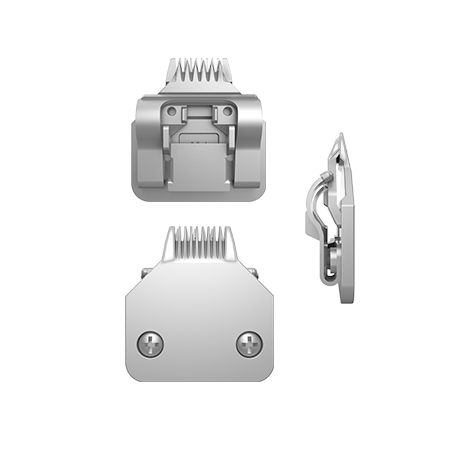
4. T-Blades (Trimmer Blades)
T-blades are the precision instruments of the barbershop. Named for their T-shaped profile — the blade extends wider than the trimmer housing — they create the crisp, clean lines that define a professional haircut. The exposed corners allow barbers to carve straight lines, sharp angles, and even intricate designs.
T-blade characteristics
- Cutting width: 40-42mm (wider than the housing for visibility)
- Zero-gap capable: Yes — the moving blade can be adjusted flush with the guide blade for 0.0mm cutting
- Primary use: Line-ups, edge-ups, beard outlines, design work
- Material: 440C stainless steel (HRC 58-62) or carbon steel (HRC 60-65)
Zero-gapping a T-blade is an essential barber skill. By loosening the blade screws and sliding the cutting blade forward until it is flush with the guide blade, you achieve the closest possible cut — right at skin level. Our Model 125 T-Blade is specifically designed for zero-gap adjustment with precision-ground teeth that align cleanly at flush position.
Professional models using T-blades: Andis Slimline Pro Li, Andis GTX-EXO, BaByliss FX787/FX788, Wahl Detailer Li, Gamma+ Absolute Hitter.
5. U-Blades (Detail Blades)
U-blades have rounded corners and a narrower cutting width (32-38mm) compared to T-blades. The rounded profile eliminates the sharp corners that can nick skin during detail work around ears, necklines, and contoured areas. U-blades are the safer choice for barbers working on sensitive skin or doing close work in tight areas.
While T-blades excel at straight-line work, U-blades are better for curved work — following the natural contour of the hairline behind the ears, shaping curved necklines, and blending around the temporal area. Many experienced barbers keep both types on their station.
Our Model 730 and Model 780 U-Blades feature rounded safety corners and extra-fine teeth designed specifically for contour work and sensitive skin contact.
6. Ceramic Moving Blades
Ceramic blades are not a separate blade type — they are replacement moving blades made from zirconia ceramic (ZrO2) instead of steel. The ceramic moving blade pairs with a standard steel stationary blade, creating a hybrid that combines ceramic's heat and wear advantages with steel's structural strength.
Why ceramic matters
| Property | Steel Moving Blade | Ceramic Moving Blade |
|---|---|---|
| Edge retention | Baseline | 5x longer |
| Heat generation | 100% (baseline) | 25% (75% less heat) |
| Corrosion resistance | Good (stainless) / Poor (carbon) | Immune |
| Drop resistance | Excellent | Poor (can chip) |
| Cost | $$ | $$$$ |
For pet groomers doing 6-8 hour grooming sessions, ceramic blades are often essential — steel blades heat up enough to cause skin burns on animals after 15-20 minutes of continuous use. Ceramic blades stay comfortable throughout the entire session. Barbers doing high-volume fade work also benefit from ceramic's cooler operation. See our complete ceramic blade range and ceramic vs steel comparison.
7. Specialty Blade Types
Foil shaver blades
Foil blades use a perforated metal screen over oscillating cutters. Hair enters through the screen holes and is cut by the blade underneath — without the blade touching skin directly. This makes foils the safest way to achieve a 0.0mm "bald" finish. In the barber workflow, foil shavers handle the final step of a skin fade: clipper (bulk removal) → trimmer (outline) → foil (skin fade zone).
Sheep shearing blades
Shearing blades are heavy-duty cutting tools designed for livestock wool. They consist of a wide comb (bottom blade) with 13 or more teeth and a narrow cutter (top blade) that oscillates across the comb. Shearing blades are made from hardened tool steel and must be sharpened on a flat disc lapping machine between uses. Compatible with Lister, Heiniger, and similar shearing handpieces. See our pet and animal blade range.
Nose and eyebrow trimmer blades
Micro-precision blades for personal care devices. Nose trimmer heads use either rotary (dual-edge inner cutter inside a slotted outer guard) or reciprocating mechanisms. Eyebrow blades are ultra-fine tooth designs with safe tip profiles. These blades require tight clearances (0.02-0.05mm between cutter and guard) and hypoallergenic stainless steel. See our precision small blade catalog.
How to Build Your Blade Collection
For barbers starting out or expanding their toolkit, here is a practical progression:
- Essential (day one): One clipper with a standard taper blade + one T-blade trimmer
- Intermediate (3-6 months): Add a fade blade clipper + a foil shaver
- Advanced (1+ year): Add a U-blade trimmer for detail work + ceramic replacement blades for heat management
- Specialist (high-volume fades): Dedicated fade clipper with ceramic blade + zero-gapped T-blade + foil shaver = the complete fade workflow without any blade heating issues
For pet groomers, the progression is different: start with #10 and #7F A5 blades (the two most-used sizes), then add #5F, #30, and #40 as needed. Invest in ceramic moving blades early — heat management is non-negotiable in animal grooming.
Related Guides
- Clipper Blade Size Chart — Every A5 blade size in mm with use cases
- Clipper Blade Steel Grades Explained — 420 vs 440A vs 440C vs carbon steel vs ceramic
- T-Blade vs U-Blade vs Foil — Deep dive into precision trimmer blades
- Ceramic vs Steel Clipper Blades — Detailed material comparison
- Blade Compatibility Guide — Which blades fit which clippers