
Clipper Blade Country of Origin Marking: US Rules | SUMTHIN
US law lists clippers and their parts under 19 CFR 134.43: mark by stamping, etching or engraving, not ink. Where Made in China goes on a blade, and the Japanese steel trap.
Last updated: October 13, 2026. Regulation text checked against 19 U.S.C. 1304 and 19 CFR Part 134, and CBP rulings checked in the CROSS database on this date.
Quick answer: Every China-made clipper blade imported into the US must tell the end buyer "China", either on the blade or, when the blade reaches the buyer in a sealed retail pack, on that pack. Blades are a special case. 19 CFR 134.43(a) names "clippers, shears, scissors, safety razors, blades for safety razors ... and parts of the above articles" as goods whose marking must be die stamped, cast in the mold, etched or engraved, so ink printing and stickers on the blade itself do not count. And if the blade carries the name of any other country, for example a "Japanese Steel" etch, then "Made in China" has to sit on the same surface in a comparable size (19 CFR 134.46).
- Get it wrong and CBP charges a 10% ad valorem marking duty under 19 U.S.C. 1304(i) that "shall not be remitted". On 5,000 A5 blades at $2.60 FOB, that is $1,300 on top of the 37.5% Section 301 stack.
- Ink printing and paper labels are acceptable for most goods (19 CFR 134.44), but not on the blade for 134.43(a) articles. Use laser engraving, etching, die stamping or lettering molded into the MIM part.
- Box-only marking is allowed when the blade will reach the end buyer in its unopened, marked container (19 CFR 134.32(d), HQ 734154). It fails when salons, groomers or distributors split packs.
- Any non-origin country name on the blade or its box ("Japanese 440C", "German steel", "Solingen") triggers 134.46. CBP ruled Chinese knives etched "German Stainless Steel" not legally marked (NY H81281).
We have made clipper blades in Haining, Zhejiang since 2004. Marking is decided at the sampling stage, at the same time as your logo, and it is one of the few specs that can stop a whole container at the port. The questions we hear from private-label buyers are always the same. Do I have to put "Made in China" on the blade? Can it go on the box only? Can we keep "Japanese steel" on the label? This guide answers each one with the regulation text and the CBP rulings behind it. It is the follow-up to our clipper blade HS code and import duty guide.
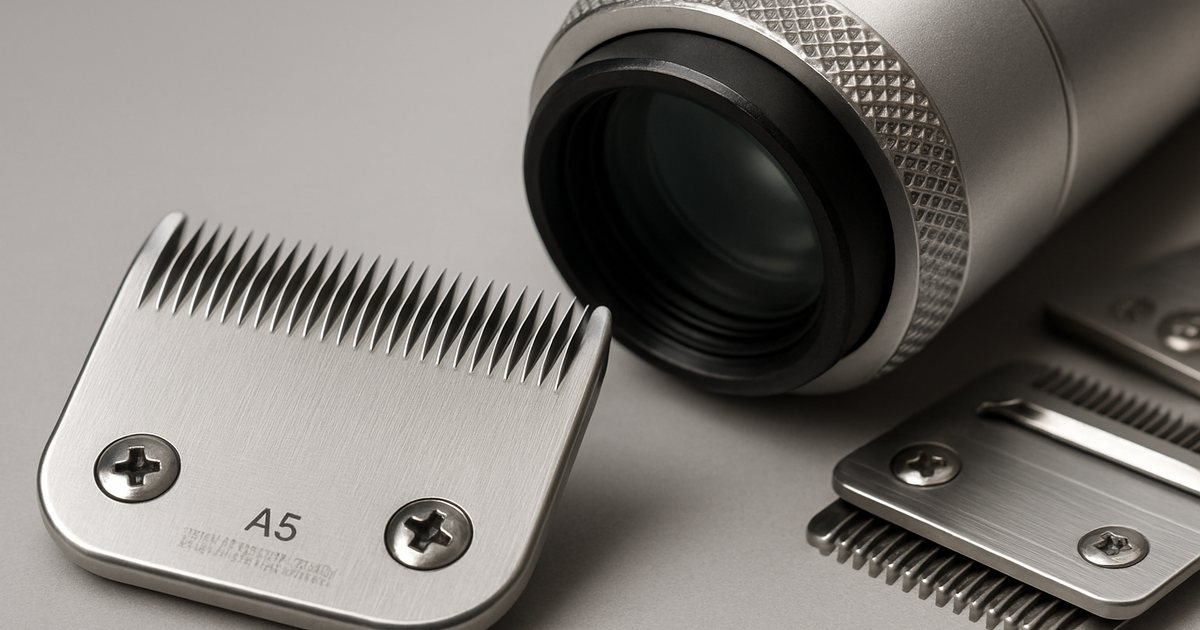
The Three Layers of US Origin Marking Law for Blades
Most importers know the general rule. Few know that cutting tools sit under two extra layers. Here is how they stack:
| Layer | Legal source | What it requires | What it means for a clipper blade |
|---|---|---|---|
| 1. General rule | 19 U.S.C. 1304(a); 19 CFR 134.11, 134.41 | English name of the origin country, conspicuous, legible, as permanent as the article allows, readable by the ultimate purchaser "without strain" | "Made in China" (or "China") on the blade or, where an exception applies, on its container |
| 2. Special methods | 19 CFR 134.43(a) | Die stamping, cast-in-the-mold lettering, etching (acid or electrolytic), engraving, or a metal plate fixed by welding, screws or rivets | Covers "clippers ... safety razors, blades for safety razors ... and parts". Ink and stickers on the blade do not satisfy it |
| 3. Misleading names | 19 CFR 134.46, 134.47 | If "USA", a US place, or any other country's name appears, the true origin goes in close proximity and in comparable size | "Japanese Steel", "German Engineered", or a brand like "Brooklyn Barber Co." needs "Made in China" next to it |
Layer 2 comes from the original Tariff Act of 1930, which singled out cutlery and similar tools because a stamped mark survives where a paper label falls off. CBP still applies it. In NY L86030 (a steel utility knife from China) and NY 888642 (a razor sold with a shaving-cream dispenser), CBP restated the 134.43 method rule for knives and for "safety razors and blades for safety razors".
Do Electric Clipper Blades Count as "Clippers" Under 134.43(a)?
Here we want to be precise rather than alarmist. The regulation says "clippers" and "parts of the above articles", and it does not say "manual" or "electric". However, in NY N300628 (2018), a ruling on a cordless pet clipper with stainless and ceramic blades (HTS 8510.20), CBP applied only the general permanence rule of 134.41 and 134.44 and did not mention 134.43. We found no published CBP ruling that applies 134.43(a) to electric clipper blades under 8510.90, and none that excludes them.
So the strict reading is uncertain. In practice it doesn't matter, because a 134.43-compliant mark costs almost nothing on a blade line and also meets the general rule. For US-bound orders we recommend a worked-in mark unless you have a confirmed box-only exception (see below). On a blade that already gets a laser logo, it is just one more line on the laser file. If the reading goes against you, the cost is the 10% marking duty, plus re-marking under CBP supervision or re-export.
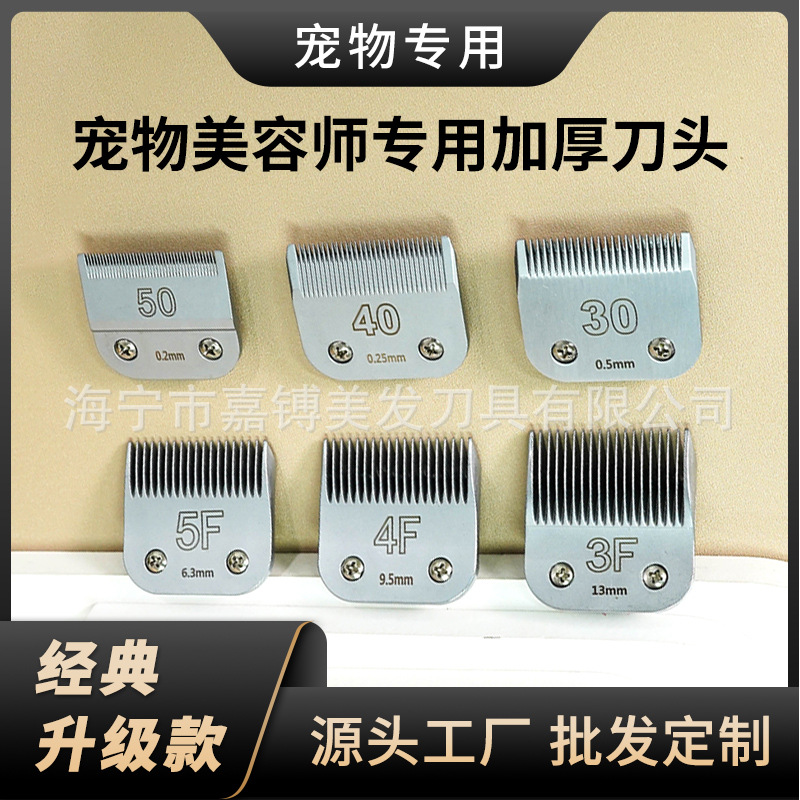


| Product | Where we place the mark | Our default method | Typical text height |
|---|---|---|---|
| A5 detachable blade | Heel of the stationary (comb) blade, next to the size number | Fiber laser engraving | 0.8-1.2 mm |
| Ceramic blade | Steel comb plate. The zirconia cutter is a moving part and wears | Fiber laser engraving | 0.8-1.2 mm |
| MIM blade body | Non-cutting face, molded in | Cast-in-the-mold lettering (scaled for sintering shrink) | 1.0 mm after sintering |
| Trimmer T-blade / U-blade | Back face of the fixed blade, away from the teeth | Fiber laser engraving | 0.6-0.8 mm |
| Sheep shearing comb / cutter | Comb heel, opposite the bevel | Die stamping before hardening | 1.5-2.0 mm |
Text heights are our production defaults, not a legal minimum. 134.41(b) only requires that the purchaser can find the marking easily and read it without strain. On a 23 mm-wide A5 heel, 1 mm capitals can be read without a loupe.
Marking Methods Compared on a Hardened Blade
A clipper blade is not an easy surface. It is 440C or MIM steel at HRC 58-62, often with a mirror-lapped face, and it goes through Barbicide, blade wash and sometimes regrinding before it reaches the next customer. The methods behave very differently:
| Method | Named in 134.43(a)? | Works on HRC 60 steel? | Survives disinfectant and cleaning | Our view |
|---|---|---|---|---|
| Fiber laser engraving (material removed, about 0.02-0.05 mm deep) | Yes, as engraving | Yes, done after heat treatment | Yes | Default for A5, ceramic and T-blades |
| Electrolytic etching | Yes | Yes | Yes | Fine. Slower and needs a stencil per artwork |
| Cast-in-the-mold lettering (MIM) | Yes | Formed before sintering | Yes | Best for 50,000+ pcs per design. The tool insert must be scaled for about 15-20% linear shrink |
| Die stamping | Yes | No. It must be done before hardening | Yes | Good on thick shearing combs. On thin A5 heels it can distort flatness, and the blade then needs re-lapping |
| Laser annealing / "black marking" (oxide colour change, no material removed) | Not by name | Yes | Usually, but it can fade with aggressive passivation | Looks premium, but it is a grey zone for 134.43. We do not use it alone for the origin line |
| Pad printing / ink | No | Yes | No, it wipes off in blade wash | Logo decoration only. Never the origin mark on the blade |
| Sticker or hang tag | No | n/a | No | Acceptable on the box. Not a substitute for marking the blade |
The laser annealing row is the one we argue about most with design-led brands. The black mark looks better than a frosted engraving, but 134.43 lists engraving and etching, which remove metal, and annealing does not. We have not found a ruling either way. The safe solution costs nothing: anneal the logo, and engrave the origin line.

When Marking Only the Retail Box Is Enough
19 U.S.C. 1304(a)(3)(D), carried into 19 CFR 134.32(d), excepts an article from individual marking when "the marking of the containers will reasonably indicate the origin". CBP has held for decades that this exception also overrides the 134.43 special methods. In HQ 734154 (1991), stainless flatware (a 134.43 article) shipped to restaurants in marked cartons was excepted. NY G83008 (2000) applied the same reasoning to nail clippers and scissors in a marked retail kit.
The condition is strict: CBP must be satisfied that the article will in all foreseeable circumstances reach the ultimate purchaser in its marked, unopened container. In C.S.D. 80-44, CBP refused the exception for flatware in retail "presentation packs", because shoppers open them to look at the goods. Apply that to blade sales channels:
| How the blade reaches the end user | Box-only marking likely OK? | Why |
|---|---|---|
| Sealed blister or clamshell, sold one per pack on Amazon or in retail | Usually yes | The buyer receives it in the marked, unopened pack |
| Barber-supply distributor buys 50-blade cartons and sells single blades over the counter | No | The carton is opened before the ultimate purchaser sees the blade |
| Hinged display box that shops open for customers to inspect blade teeth | No | Same logic as the C.S.D. 80-44 presentation packs |
| Blades packed with a clipper kit you sell as one unit | Often yes, for the blade | The kit box is marked. The clipper body itself still needs its own mark |
| Sharpening services and mobile groomers reselling spare blades loose | No | The blade travels without its container |
Most of our private-label customers sell through more than one of these channels within a year, so we recommend marking the blade even when the launch channel is sealed retail. A blade that is already marked can go to any channel later. A blade that is not marked locks you into one channel, and pallets of blister packs do get broken down by distributors.
The "Japanese Steel" Trap: 19 CFR 134.46 and NY H81281
"Japanese steel" is one of the most common claims on blade packaging, as our clipper blade steel grades guide explains. When the blade or its box says "Japan", "German" or "Solingen" but the blade was made in China, 134.46 applies. The true origin must appear "legibly and permanently in close proximity to such words ... and in at least a comparable size".
CBP has already ruled on this exact pattern. In NY H81281 (June 2001), knives die-cut and edged in China from German stainless sheet were etched "German Stainless Steel". CBP held that "since the articles are, in fact, manufactured in China, they are not legally marked and the marking as shown is deceptive", and required the knives to also be etched "Made in China". It added that close proximity means the origin must "generally appear on the same side(s) or surface(s)" as the other country name. The steel's origin does not change where the blade was made, because grinding, heat treatment and lapping happen in our factory.
| Text on blade or box | Compliant? | Fix |
|---|---|---|
| "JAPANESE 440C STEEL" on the blade face, "Made in China" on the box only | No | Engrave "MADE IN CHINA" on the same face, same height |
| "Japanese Steel" in 14 pt on the box front, "Made in China" in 6 pt on the box bottom | No | Same panel, comparable size |
| "440C STAINLESS / HRC 60 / MADE IN CHINA" | Yes | Spec the grade, not a country. It is also more useful to buyers |
| Brand "Brooklyn Blade Co." engraved, no origin on the blade | No | A US place name in the brand triggers 134.46 and 134.47. Add "MADE IN CHINA" next to it |
| "Designed in California" on the box | Only with origin next to it | "Designed in California, Made in China" on the same line |
Our honest advice is to drop country-of-steel claims entirely. "440C, HRC 60-62" tells a professional barber more than "Japanese steel", it needs no extra origin line, and it can be checked with a hardness tester. Our pre-shipment inspection guide covers how to verify it.
What Happens If the Marking Is Wrong
Marking problems are found at entry examination, and a container of blades is easy to inspect. The consequences escalate:
- Notice to mark / redeliver (CBP Form 4647). Unmarked goods must be marked under CBP supervision, re-exported or destroyed before liquidation. Laser-engraving 5,000 blades in a US bonded warehouse costs far more than doing it on our line.
- 10% marking duty, 19 U.S.C. 1304(i). If the goods are not properly marked, exported or destroyed in time, a 10% ad valorem duty applies. It "shall not be construed to be penal, and shall not be remitted wholly or in part". It is charged on top of normal duties.
- Criminal penalties, 19 U.S.C. 1304(l). Anyone who removes, covers or obliterates a required mark with intent to conceal origin faces up to $100,000 and one year for a first offence, and $250,000 for repeat offences. This catches resellers who grind off or sticker over "China".
- False origin, 19 U.S.C. 1592. Marking China-made blades "Made in Vietnam" or "Made in USA" to dodge Section 301 is a false statement to CBP. The penalty runs up to the domestic value of the goods for fraud. See the Vietnam section of our HS code and duty guide for what substantial transformation does and does not cover.
- FTC "Made in USA" rule, 16 CFR Part 323. Re-sharpening, re-boxing or engraving imported blades in the US does not make them "Made in USA". Unqualified claims carry civil penalties of over $50,000 per violation.
| 5,000 A5 blades at $2.60 FOB ($13,000 entered value) | Correctly marked | Unmarked, not corrected before liquidation |
|---|---|---|
| MFN duty (8510.90.10) | $0 | $0 |
| Section 301 List 3 (25%) + forced-labor 301 (12.5%) | $4,875 | $4,875 |
| Marking duty, 1304(i), 10% | $0 | $1,300 |
| Extra cost per blade | - | +$0.26, about 10% of FOB, never refundable |
The $0.26 per blade is roughly the whole margin difference between a mid-range and a budget blade, and it is lost to a line of text that would have taken the laser about a second per piece.

How We Handle Origin Marking on Private-Label Orders
- Artwork stage. You send your logo (AI/SVG) and target markets. We lay out logo, size number and "MADE IN CHINA" on the actual heel drawing at 1:1, and flag any 134.46 trigger words such as country names in the brand or tagline.
- Sample stage. Samples are marked with the production method, not a quick ink print, so your broker or a CBP ruling request can be based on a real sample.
- Packaging. The retail box carries "Made in China" on the principal display panel, or on the same panel as any foreign or US place name. Master cartons are marked too.
- Inspection. Add mark legibility, position and permanence to your inspection checklist alongside sharpness and hardness. A simple test is an alcohol rub plus a soak in disinfectant at the label dilution. See our wholesale quality specs guide.
- Documents. The commercial invoice states "Country of origin: China" for every line, matching the marking, the MID and the Chinese export declaration.
If you are unsure about a specific design, especially box-only marking or a brand name containing a place name, you can request a binding CBP ruling under 19 CFR Part 177 through the eRulings portal. There is no fee, and we can supply marked samples for the request.
Origin Marking Outside the US
| Market | Mandatory origin mark on blades? | What is required instead |
|---|---|---|
| United States | Yes. 134.43 methods on the blade, or the container exception | As described above |
| European Union | No general origin-marking law for blades | GPSR (EU) 2023/988: manufacturer name and postal and electronic address, plus an EU-based responsible economic operator, on the product or, where not possible, the packaging. A voluntary "Made in" claim must be true |
| United Kingdom | No general requirement | Producer identification under UK product safety rules. Misleading origin claims are an unfair trading offence |
A blade engraved for the US ("MADE IN CHINA" plus your logo) is accepted in the EU and UK too, so one marking file covers all three markets. The reverse does not hold: an EU-spec blade with only a logo cannot simply be redirected to a US customer.

Frequently Asked Questions
Do clipper blades need to say Made in China on the blade itself?
Yes, unless the blade will reach the end buyer in a sealed, marked retail pack. 19 CFR 134.43(a) lists clippers, razor blades and their parts as articles that must be marked by stamping, molding, etching or engraving. Box-only marking is allowed only under the container exception of 19 CFR 134.32(d).
Is laser marking acceptable for country of origin on blades?
Laser engraving that removes metal is a form of engraving, which 134.43(a) names. Laser annealing, which only changes the surface colour, is not named and has no CBP ruling either way, so we use engraving for the origin line and keep annealing for logos.
Can I sell blades marked Japanese steel if they are made in China?
Only if Made in China appears on the same surface in a comparable size. Under 19 CFR 134.46 and CBP ruling NY H81281, a China-made blade etched with another country name is not legally marked otherwise. Stating the steel grade, such as 440C, avoids the problem.
What is the penalty for importing unmarked clipper blades?
Goods must be marked under CBP supervision, re-exported or destroyed. If that is not done before liquidation, a 10% ad valorem marking duty applies under 19 U.S.C. 1304(i), and it cannot be refunded. Removing a required mark to hide origin can be a crime under 1304(l).
Is sharpening or engraving imported blades in the US enough to call them Made in USA?
No. Sharpening, re-boxing or engraving a logo does not substantially transform a blade, so the origin stays China for customs, and the FTC Made in USA rule in 16 CFR Part 323 forbids unqualified USA claims.
Does marking add to the unit price?
Very little. On A5 and ceramic blades that already carry a laser logo, the origin line adds seconds of machine time and we quote it together with the logo marking. Molded-in lettering on MIM parts needs a one-time tool insert, which we quote with the mold.
Related Guides
- Clipper blade HS code 8510.90 and US import duty
- Clipper blade pre-shipment inspection and AQL sampling
- How to source OEM clipper blades from China
- Clipper blade steel grades: 420, 440A, 440C and ceramic
- Metal injection molding (MIM) for blade parts