
Clipper Blade Pre-Shipment Inspection: AQL Sampling & Defect Classification Guide [2026] | SUMTHIN
How pre-shipment inspection actually works for clipper blade orders: AQL sampling plan by lot size, critical/major/minor defect classification, and what QC inspectors check before your shipment leaves the factory.
Quick answer: A pre-shipment inspection (PSI) for a clipper blade order does not mean someone opens a few boxes and eyeballs the blades. It means an inspector pulls a statistically defined sample size from the finished, packed lot — using the ANSI/ASQ Z1.4 (equivalent to ISO 2859-1) sampling tables — and checks each piece against a written defect list split into critical, major, and minor categories. The lot passes or fails based on a fixed accept/reject number, not on the inspector's opinion. Most brands who source clipper blades never see this process; they only see the pass/fail report, or find out it did not happen when a customer complaint arrives.
We run pre-shipment inspection on every OEM and private label order that leaves our Haining, Zhejiang factory, whether the buyer sends a third-party inspector or relies on our internal QC report. This guide walks through the actual sampling math, the defect categories specific to clipper blades, and what happens when a lot fails — the parts of quality control that our own wholesale buying guide lists as specifications to require but does not walk through step by step.
Why This Step Gets Skipped — and What It Costs
Most first-time importers treat inspection as optional overhead, especially at 500–2,000 piece MOQs where a $250–$400 inspection fee feels large relative to order value. The blades that cause the most expensive problems are not the ones that fail obviously at unboxing — they are the ones that pass a visual glance but fail a real test: a batch of 440C blades heat-treated to HRC 52 instead of the specified HRC 60 will cut hair perfectly fine in a 30-second demo and then dull within two weeks of professional use. Tooth spacing 0.03mm out of tolerance will not be visible to the eye but will cause hair-skipping that groomers notice on the first cut. Neither defect shows up without measurement.
The buyers who skip PSI on their first 1–2 orders and rely only on a supplier's word almost always add it back by the third order — usually after a return shipment or a distributor complaint made it clear that "the sample looked good" is not the same as "the production lot matched the sample."
The Three Inspection Stages — and Which One Actually Catches Blade Defects
Quality control on a clipper blade order can happen at three points in production. Each catches different problems, and PSI is the only one that reflects what actually ships:
| Stage | Timing | % of Order Complete | What It Catches | What It Misses |
|---|---|---|---|---|
| DPI (During Production) | Early production run | 10–30% | Process setup errors: wrong steel batch, tooling misalignment, coating line issues | Problems that develop later in the run (die wear, batch-to-batch heat treat drift) |
| DUPRO (During Production) | Mid-production | 50–80% | Consistency drift across the run, early packing issues | Final packed carton condition, last-batch heat treat lots |
| PSI (Pre-Shipment) | 100% packed, before loading | 95–100% | The actual condition of what ships: final packing, labeling, full-lot sampling, carton drop test | Nothing representative of the lot — this is the last checkpoint before the goods leave the factory |
For clipper blades specifically, we recommend PSI as the minimum non-negotiable inspection for any order above 2,000 pieces, with DUPRO added for first-time suppliers or orders above 20,000 pieces where a defect discovered at 100% completion is expensive to rework.
AQL Sampling Plan: How Many Blades Actually Get Checked
Inspectors do not check every blade in a shipment — that would take days and defeats the purpose of statistical sampling. Instead, the sample size is fixed by lot size using the ANSI/ASQ Z1.4 tables (the US-adopted equivalent of ISO 2859-1), General Inspection Level II, which is the level used in the overwhelming majority of hardware and tooling contracts, including clipper blades:
| Lot Size (pieces) | Sample Size Code | Sample Size |
|---|---|---|
| 501–1,200 | J | 80 pieces |
| 1,201–3,200 | K | 125 pieces |
| 3,201–10,000 | L | 200 pieces |
| 10,001–35,000 | M | 315 pieces |
A 2,000-piece OEM order (code K, sample size 125) means the inspector pulls 125 blades at random from the packed cartons — not from a box the factory sets aside — and every measurement in this article is performed on those 125 pieces. The exact accept/reject numbers for each AQL level shift by code letter, so always confirm the current Ac/Re figures with your inspection provider's Z1.4 or ISO 2859-1 table rather than assuming last year's numbers still apply; the worked example below (code K) is stable and widely published.
Defect Classification: Critical, Major, and Minor for Clipper Blades
Every defect found in the sample gets logged against one of three severity classes, each with its own acceptance threshold. This is the part most buyer-facing guides skip because it requires blade-specific judgment, not a generic checklist:
| Class | Definition | Clipper Blade Examples | Typical AQL Applied |
|---|---|---|---|
| Critical | Could injure the end user or make the product unusable | Loose or detached tension spring; sharp burr on the blade back edge (not the cutting edge); wrong bore/hook geometry that prevents mounting on the clipper | Zero tolerance (Ac 0 / Re 1) |
| Major | Fails a functional spec but does not create a safety hazard | Rockwell hardness below minimum (HRC <58 for 440A, <60 for 440C); tooth spacing beyond ±0.02mm; CATRA edge sharpness below 200mm TCC; chrome adhesion below 4B cross-hatch rating | AQL 2.5 |
| Minor | Cosmetic only, does not affect function or fit | Light surface scuffing not visible beyond 30cm; minor color variation between coating batches; blade-number engraving slightly off-center but legible | AQL 4.0 |
For a 2,000-piece order (sample size 125, code K), the standard AQL 2.5 major-defect acceptance number is 7 pieces (Ac 7 / Re 8) — meaning the lot passes if 7 or fewer of the 125 sampled blades show a major defect, and fails at 8 or more. Critical defects use a zero-tolerance rule regardless of sample size: even a single critical defect (Ac 0 / Re 1) fails the lot, because a detached tension spring or mounting-geometry error is not something averaging across a sample makes acceptable.
What an Inspector Physically Checks on Inspection Day
A real PSI for clipper blades follows a fixed sequence, not a free-form walkthrough:
- Carton selection: Random cartons are pulled from across the pallet stack (top, middle, bottom, different pallets) — not just the most accessible boxes — to avoid a supplier presenting only their best cartons.
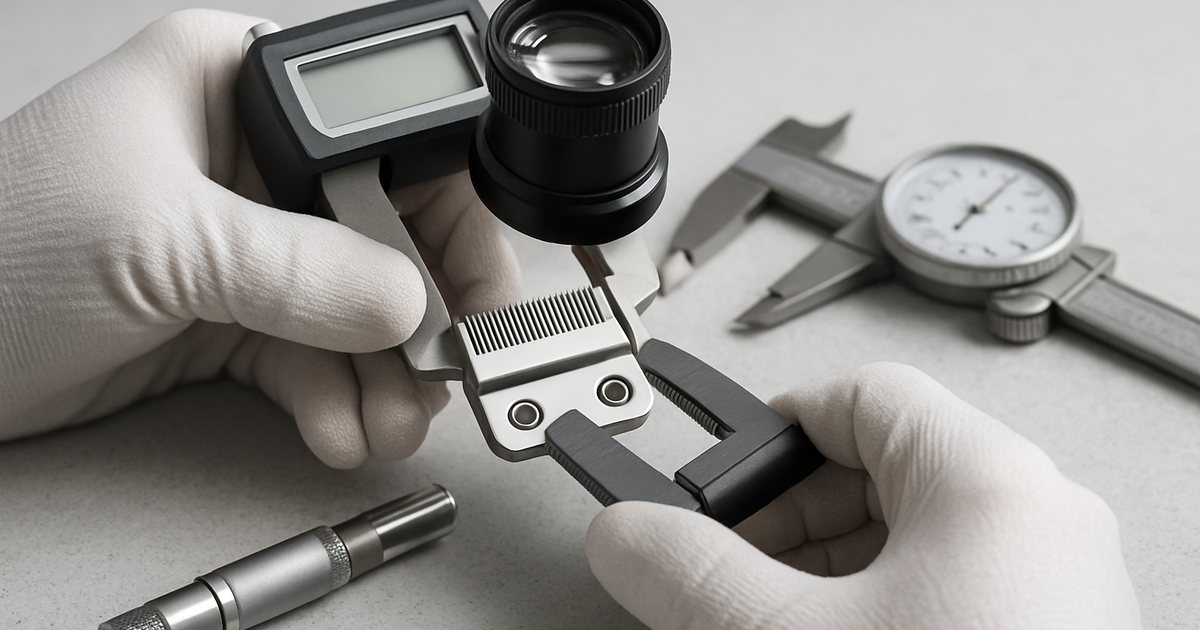
- Visual and dimensional check: Each sampled blade is checked under a loupe or low-power microscope for burrs, chips, and coating defects, then measured with a digital caliper for tooth spacing and blade flatness against the approved golden sample.
- Rockwell hardness spot check: A portable Rockwell tester verifies HRC on 3–5 blades per lot (destructive test performed on units already sampled for scrap, not on sellable stock).
- Edge sharpness (CATRA test): A calibrated cutting rig measures total depth of cut on a standardized test material; professional-grade blades must clear 200mm minimum TCC.
- Tension spring force test: A calibrated tension gauge confirms the blade drive clamps within the specified 1.2–1.8 kgf range — too loose causes chatter, too tight causes premature motor wear.
- Coating adhesion: ASTM D3359 cross-hatch tape test on chrome, TiN, or DLC-coated blades, checked against the 4B/5B minimum rating.
- Function test: A sample of assembled blade sets is run on a test clipper against synthetic test fiber to confirm clean cutting without skipping or snagging.
- Packaging and labeling: Blister card or poly bag integrity, compatibility labeling accuracy (see our detachable vs fixed blade OEM guide for why mislabeling compatibility is a common private-label defect), and a carton drop test on a percentage of shipping cartons.
Accept/Reject Math: A Worked Example
Take a real order profile: 2,000 pieces of a private-label 440C A5 blade, packed and ready to ship.
- Lot size 2,000 falls in the 1,201–3,200 range → sample size code K → 125 pieces sampled.
- The inspector finds 4 blades with tooth spacing outside ±0.02mm tolerance (major defect) and 9 blades with minor coating color variation (minor defect). No critical defects found.
- Major defect count (4) is below the Ac 7 threshold → passes on major defects.
- Minor defect count (9) is compared against the AQL 4.0 acceptance number for code K, which is higher than the major threshold — in this scenario it also passes.
- Result: the lot passes and ships, with the 4 major-defect and 9 minor-defect findings logged in the inspection report as data for the next production run's process control, not as a reason to hold the shipment.
If the major defect count had been 8 or more instead of 4, the entire lot would fail regardless of how good the other 117 sampled blades were — this is the part new importers find counterintuitive: statistical sampling protects against systemic problems, not against every individual defective piece slipping through.
Third-Party QC Firm vs. Factory Self-Inspection Report
Buyers have two options for who performs PSI, and they are not equivalent:
| Option | Typical Cost | Independence | Best For |
|---|---|---|---|
| Third-party QC firm | $250–$400 per inspector per day | Independent of the factory; report goes directly to the buyer | First 2–3 orders with a new supplier, any order the buyer has not personally audited the factory for |
| Factory self-inspection report | Usually included in the order price | Performed by factory QC staff; report reflects the factory's own sampling | Repeat orders with an established supplier relationship and a track record of consistent third-party results |
We provide a factory self-inspection report with hardness certificates and CATRA test data on every order as standard, and we also accommodate third-party inspectors (QIMA, SGS, Bureau Veritas, or independent inspectors) at no additional access fee — a supplier that resists a buyer's own PSI booking is itself a signal worth noting.
What Happens After a Failed Inspection
A failed PSI is not the end of the order — it is the start of a negotiation with three common resolutions:
- 100% sort and rework: The factory re-inspects and reworks the entire lot (not just the sample), then schedules a re-inspection. This is standard for tooth-spacing or hardness failures traceable to a specific production batch.
- Partial shipment: Cartons that were not part of the failed sample's source pallets ship on schedule; the affected batch ships separately after rework.
- Price adjustment: For minor, cosmetic-only failures a buyer may accept the lot at a negotiated discount rather than delay shipment for rework — this should be a buyer decision made with the inspection report in hand, not a default outcome.
What should not happen: shipping a lot that failed on critical defects. A detached tension spring or incorrect mounting geometry is a functional failure that a discount does not fix.
What Pre-Shipment Inspection Costs — and Who Should Pay
A standard one-day PSI for a single clipper blade SKU runs $250–$400 for the inspector's day rate, plus a small report fee from most agencies. For a 2,000-piece order at $2.50–$4.50 per MIM blade (roughly $5,000–$9,000 order value), that is under 5% of order value — a small cost relative to the risk of shipping an unverified lot to a retail distributor or e-commerce fulfillment center where returns and chargebacks cost far more than the inspection fee. Most contracts place the inspection cost on the buyer, since the inspector represents the buyer's interests, not the factory's; buyers ordering 10,000+ pieces per shipment can often negotiate the factory to cover or split the fee as part of the overall unit price.
Related Guides
- How to Buy Clipper Blades Wholesale: MOQ, Steel Grades & Quality Specs
- Clipper Blade Steel Grades Explained
- OEM Clipper Blades Sourcing Guide
- Clipper Blade HS Code & US Import Duty: 2026 Landed Cost Guide
- Detachable vs Fixed Clipper Blades: OEM Guide
- Private Label Clippers & Blades: EU GPSR Compliance