
Weed Whacker Blades & Brush Cutter Blades: Types & Wholesale Sourcing (2026)
Complete buyer's guide to weed whacker and brush cutter blade types: tooth counts, 65Mn vs SK5 vs carbide, hardness specs, EN ISO 11806 certification, FOB China pricing ($1.50-25/pc) and MOQ. Written by a blade manufacturer.
Quick answer: Weed whacker and brush cutter blades fall into five families — 2-4 tooth grass blades, 8-tooth chisel blades, 40-80 tooth carbide circular saw blades, smasher/flail blades, and nylon or copolymer blades. Match tooth count to vegetation: 8 teeth or fewer for grass and light weeds, 9-40 teeth for woody weeds and shrubs, 40-80 carbide teeth for saplings. Steel grade and hardness matter more than tooth count: 65Mn at HRC 42-48 for grass, 30CrMnSi or SK5 at HRC 50-55 for brush. Wholesale FOB China pricing runs $1.50-25.00 per blade depending on type, with 5,000-10,000 piece MOQ for standard designs.
We are a precision blade manufacturer in Haining, China. Most of our output is grooming and razor blades, but the same stamping, heat-treatment and edge-grinding lines produce outdoor power equipment blades — and importers ask us the same set of questions every season. This guide is written for the buyer specifying a trimmer blade line, not for the homeowner buying one blade at Home Depot.
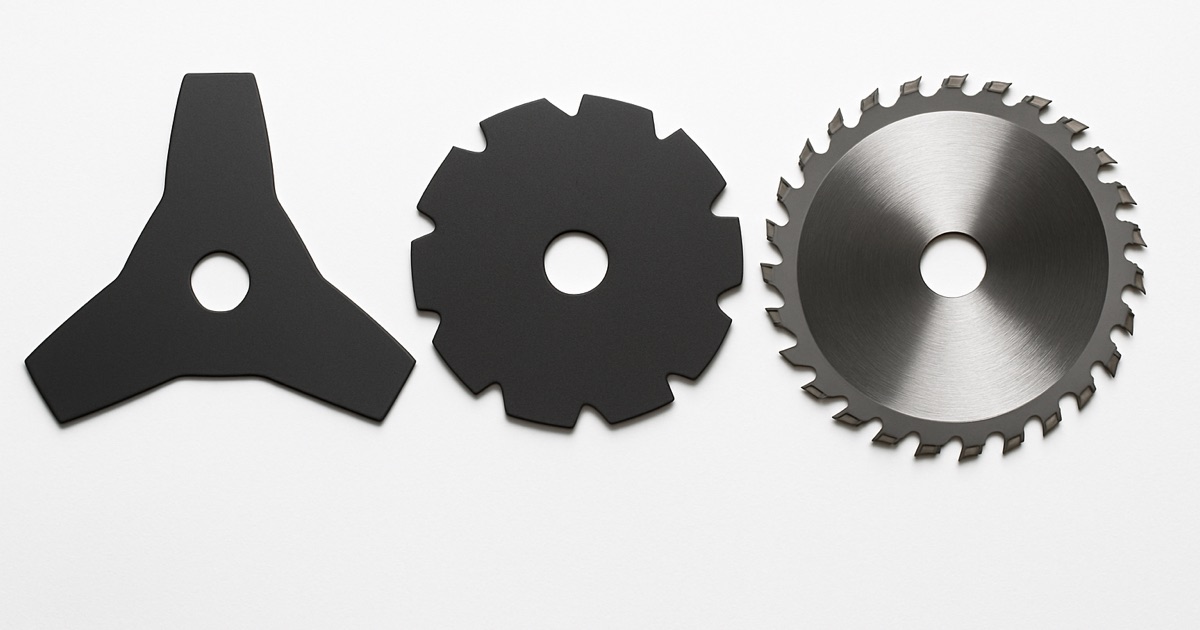
The Five Blade Families
| Type | Teeth | Typical material | Hardness | Cuts | FOB China |
|---|---|---|---|---|---|
| Grass / knife blade | 2-4 | 65Mn carbon steel | HRC 42-48 | Grass, soft weeds | $1.50-4.00 |
| Brush blade | 3-8 | 65Mn / 30CrMnSi | HRC 48-52 | Thick weeds, light brush | $3.00-8.00 |
| Chisel blade | 8-40 | SK5 high-carbon steel | HRC 50-55 | Dense vegetation, blackberry | $5.00-12.00 |
| Carbide circular saw | 40-80 | 65Mn body + YG8 carbide tips | Tips HRA 89-91 | Saplings to 4 in / 100mm | $8.00-25.00 |
| Smasher / flail | 0 (blunt) | Thin spring steel | HRC 38-44 | Watery weeds, soft grass | $2.00-6.00 |
| Nylon / copolymer | 2-8 flails | PA66 + glass fibre | n/a | Lawn edges, near fences | $0.80-3.00 |
Grass and knife blades (2-4 tooth)
The default metal blade shipped with most brush cutters. It cuts by slicing, works at any head speed, and is cheap enough to be treated as a consumable. Stamped from 2.0-2.5mm 65Mn sheet, heat treated to HRC 42-48 — deliberately soft so the blade bends rather than shatters when it strikes a rock. That toughness-over-hardness trade is the single most important spec on the drawing.
Chisel blades (8-40 tooth)
Higher tooth counts cut smaller bites, which produces a cleaner finish and less kickback in dense material. The trade-off is that each tooth dulls sooner and the blade demands more engine power to keep tip speed up. Beyond about 24 teeth, most buyers are better served by a carbide-tipped design.
Carbide-tipped circular blades (40-80 tooth)
Brazed tungsten carbide inserts on a 65Mn steel body. Edge life is roughly 10-20x plain steel in abrasive conditions, which is why commercial landscaping and forestry crews accept the higher unit price. The failure mode to design around is not wear, it is braze-joint failure: a tooth thrown at 300+ km/h tip speed is a serious safety event. Braze shear strength and a 100% tip-adhesion inspection belong in your quality agreement.
Smasher and flail blades
No sharp edge — these rely on thin section and momentum to break soft, watery stems. They are safer around gravel and fence lines because there is no edge to chip, and they mulch better than a knife blade. Poor choice for anything woody.
Nylon and copolymer blades
Glass-filled PA66 flails for low-RPM heads and consumer trimmers. Cheapest to produce and to ship, and the only category where injection moulding rather than stamping drives cost.
Matching Blade to Vegetation (Selection Table)
| What you are cutting | Recommended blade | Avoid |
|---|---|---|
| Lawn edges, around fence posts | Nylon line head or copolymer flail | Any metal blade (kickback and property damage) |
| Tall grass, soft weeds | 2-4 tooth grass blade, 65Mn | Carbide (overkill, 5x the cost) |
| Thick weeds, brambles, blackberry | 8-tooth chisel, HRC 50-55 | Smasher blades (they bounce off woody stems) |
| Saplings up to 25mm / 1 in | 40-60T carbide circular | Plain steel chisel (dulls in one session) |
| Saplings 25-100mm / 1-4 in | 60-80T carbide on a bike-handle brush cutter | Any loop-handle or straight-shaft consumer unit |
| Reeds, watery ditch weeds | Smasher / flail | High-tooth-count blades (clog immediately) |
| Ground-level clearing near stones | Thick 3-tooth, HRC 42-46 (bends, does not shatter) | Hardened thin blades above HRC 55 |
Materials and Heat Treatment: What Actually Determines Blade Life
Tooth count sells the blade. Metallurgy determines whether it comes back as a warranty claim.
| Grade | Equivalent | Typical HRC | Strength | Weakness |
|---|---|---|---|---|
| 65Mn | AISI 1566 | 42-48 | Tough, forgiving, cheapest | Dulls fast in abrasive soil |
| SK5 | AISI 1080 | 50-55 | Better edge retention | More brittle on rock strikes |
| 30CrMnSi | AISI 4130-class | 48-52 | Best toughness-to-hardness balance | ~20-30% higher material cost |
| YG8 tungsten carbide (tips) | ISO K30 | HRA 89-91 | 10-20x edge life | Braze joint is the weak link |
Two specification lines separate a good blade from a bad one, and both are invisible in a photo:
- Hardness uniformity, not just nominal HRC. Ask for HRC readings at five points across the blade, not one. A blade quoted at HRC 50 that actually ranges 44-56 across its face will chip at the hard spots and roll at the soft ones. Our internal acceptance band on stamped blades is plus or minus 2 HRC across all measurement points.
- Rotational balance. An unbalanced blade spinning at 8,000-10,000 rpm transmits vibration straight into the operator's hands and destroys gearbox bearings. Specify a static balance tolerance and require the supplier to document it.
If you are also sourcing precision cutting components, the same metallurgy principles apply — see our breakdown of blade steel grades (420, 440A, 440C, carbon steel) for how grade selection changes edge retention in a different blade category.
Tip Speed, RPM and Why It Matters for Your Spec
A blade does not cut with its rpm, it cuts with its tip speed. For a 255mm blade at 9,000 rpm, tip speed is roughly 120 m/s — about 430 km/h. That figure drives three design decisions:
- Blade diameter vs head speed. Flexible nylon and copolymer blades belong on heads below roughly 6,000-8,000 rpm. Carbide-tipped and hardened steel saw blades need the higher speeds — a carbide blade run slow tears rather than cuts and loads up with sap.
- Thickness scales with diameter. Common combinations: 230-255mm blades at 1.4-2.0mm thickness, 255-305mm at 2.0-3.0mm. Under-specifying thickness to save material cost is the most common cause of field deflection and blade fracture.
- Bore and arbor fit. The dominant standard is a 25.4mm (1 in) centre bore, with 20mm on some European machines. Multi-fit blades ship with a stepped reducer washer. A sloppy bore fit lets the blade run eccentric, which is a safety problem, not a quality nitpick.
Safety and Certification Requirements by Market
Blade specification is where product liability lives. Requirements you should hold your supplier to:
- EN ISO 11806-1 — the harmonised standard for portable hand-held brush cutters and grass trimmers, which underpins CE marking for the EU. It covers guard requirements, cutting-attachment strength, and marking.
- CE marking for the EU/UK, backed by a Declaration of Conformity naming the standard, not just a logo printed on the card.
- ANSI B175.3 for the US market on grass trimmer and brush cutter safety requirements.
- Marking on the blade itself: maximum rpm, diameter, direction of rotation arrow, and bore size. Missing max-rpm marking is a common non-conformity in first-article inspections.
- RoHS and REACH declarations where the blade is packaged with plastic components.
Wholesale Sourcing: MOQ, Pricing and Lead Times
China produces the large majority of the world's string trimmer and brush cutter blades. Realistic commercial terms as of 2026:
| Scenario | MOQ | Tooling cost | Lead time |
|---|---|---|---|
| Standard design, supplier's tooling | 5,000-10,000 pcs | None | 30-45 days |
| Standard blade, your logo / laser mark | 5,000-10,000 pcs | $200-800 (mark setup) | 35-50 days |
| Custom profile, new progressive die | 20,000+ pcs | $4,000-15,000 | 60-90 days |
| Custom retail packaging only | 3,000-5,000 sets | $300-1,200 (plates) | +10-15 days |
| Reorder, established SKU | 2,000-3,000 pcs | None | 20-30 days |
Two commercial notes buyers regularly get wrong. First, steel is a commodity and quotes move. 65Mn coil pricing swings enough within a year that a quote older than 60 days should be re-confirmed. Second, blades ship dense and cheap. A 40ft container carries a very large blade count, so freight per unit is small — which means the temptation to shave $0.15 off unit cost by dropping a heat-treatment step is almost never worth the warranty exposure.
For the manufacturing-process side — stamping, blanking, heat treatment, grinding and carbide tipping — see our companion article on string trimmer blade manufacturing and OEM sourcing.
Incoming Inspection Checklist for Importers
What to require on every shipment, and what to check yourself on the first three:
- Hardness report — HRC at 5 points minimum per sampled blade, with the acceptance band written into the PO.
- Dimensional report — outside diameter, thickness, bore diameter, tooth height. Bore diameter tolerance should be tight; a loose bore is the most common defect we see from low-cost suppliers.
- Flatness — lay the blade on a surface plate. Warp beyond about 0.5mm on a 255mm blade will cause visible wobble in use.
- Balance test record for all circular blades.
- Carbide tip adhesion — for tipped blades, require 100% visual inspection of braze fillets plus a destructive pull test on an AQL sample.
- Edge geometry — grind angle typically 25-35 degrees. Verify with an angle gauge, not by eye.
- Coating and corrosion — black oxide or paint coverage with no bare spots; a 24-48 hour salt-spray sample is cheap insurance for humid markets.
- Marking legibility — max rpm, diameter, rotation arrow present and readable after handling.
Run a pre-shipment inspection on the first order without exception. On repeat orders, an AQL 2.5 general inspection level II sampling plan is normal practice for this product class.
Sharpening and Replacement (What to Tell Your End Users)
Plain steel blades can be resharpened with a flat file or bench grinder, following the original grind angle, typically 25-35 degrees. Most manufacturers rate them for 3-5 resharpenings before the tooth profile is gone. Carbide-tipped blades require a diamond wheel and are generally sent to a service or replaced. Smasher and nylon blades are not sharpened at all.
Packaging that states the resharpening angle and cycle count reduces returns. It costs nothing to print and it moves the blade from "it broke" to "it wore out as documented" in the customer's mind.
Related Guides
- String Trimmer Blade Manufacturing: Materials, Processes and OEM Sourcing
- Blade Steel Grades Explained: 420, 440A, 440C, Carbon Steel and Ceramic
- Powder Metallurgy Process: The Complete 7-Step Guide
- Custom Powder Metallurgy Parts: From Drawing to Mass Production
- How to Source OEM Blades from China: Buyer's Complete Guide
Sourcing Trimmer or Cutting Blades?
SUMTHIN has manufactured precision blades in Haining, Zhejiang for over 30 years, shipping to brands in 45+ countries from a 40,000 m² ISO 9001 and ISO 14001 certified facility. Our stamping, heat-treatment, CNC grinding and metal injection moulding capacity covers grooming blades, razor blades, and precision metal cutting components for outdoor power equipment.
Send us your drawing or sample with target hardness, volume and market, and we will come back with a quote, a material recommendation, and hardness test documentation. OEM and private-label programs are available.
Frequently Asked Questions
What is the difference between a weed whacker blade and a brush cutter blade?
The terms are used interchangeably, but in practice "weed whacker blade" usually means a lighter 2-4 tooth grass blade or nylon flail for a consumer trimmer, while "brush cutter blade" means a heavier 8-80 tooth steel or carbide blade for a bike-handle machine. The mechanical difference is diameter, thickness and hardness: 1.4-2.0mm at HRC 42-48 for grass work versus 2.0-3.0mm at HRC 50-55 or carbide tipping for brush.
How many teeth should a brush cutter blade have?
Use 8 teeth or fewer for grass and light weeds, 9-40 teeth for thicker weeds and shrubs, and 40-80 carbide-tipped teeth for saplings and woody brush. Higher tooth counts give a cleaner cut and less kickback but require more engine power and dull faster in plain steel.
What steel is used for weed whacker and brush cutter blades?
65Mn carbon steel (AISI 1566) at HRC 42-48 is the volume material for grass blades because it bends rather than shatters on rock strikes. SK5 high-carbon steel at HRC 50-55 and 30CrMnSi at HRC 48-52 are used for brush blades. Premium blades add brazed YG8 tungsten carbide tips at HRA 89-91.
What is the MOQ for wholesale brush cutter blades from China?
Standard designs on the supplier's existing tooling typically require 5,000-10,000 pieces with 30-45 day lead times. Custom blade profiles requiring a new progressive die start at 20,000 pieces with $4,000-15,000 tooling cost and 60-90 day lead times. Reorders of an established SKU can drop to 2,000-3,000 pieces.
How much do brush cutter blades cost wholesale?
Typical FOB China pricing: $1.50-4.00 for 2-4 tooth grass blades, $3.00-8.00 for brush blades, $5.00-12.00 for 8-40 tooth chisel blades, and $8.00-25.00 for 40-80 tooth carbide-tipped circular blades. Nylon and copolymer blades run $0.80-3.00. Steel is a commodity, so re-confirm quotes older than 60 days.
Are carbide-tipped brush cutter blades worth the extra cost?
For commercial use, yes. Carbide tips deliver roughly 10-20x the edge life of plain steel in abrasive conditions at 3-5x the unit price, so the cost per hour of cutting is lower. For residential use with a few hours of trimming per season, plain steel is the better value. The failure risk to control is braze-joint integrity, not wear.
What certifications do brush cutter blades need for export?
EU and UK markets require CE marking supported by EN ISO 11806-1 for portable brush cutters and grass trimmers, with a Declaration of Conformity naming the standard. The US references ANSI B175.3. Blades must be physically marked with maximum rpm, diameter, rotation direction and bore size, and RoHS/REACH declarations apply where plastic components are included.
Can brush cutter blades be sharpened?
Plain steel blades can be resharpened with a flat file or bench grinder following the original 25-35 degree grind angle, typically 3-5 times before the tooth profile is exhausted. Carbide-tipped blades need a diamond wheel and are usually sent to a sharpening service or replaced. Smasher and nylon blades are not sharpened.