
The Definitive A5 Clipper Blade Guide: Sizes, Compatibility & Selection [2026]
Everything about A5 clipper blades: the universal snap-on system, all blade sizes, compatible brands, skip-tooth vs finish-cut, ceramic vs steel, and how to choose.
The A5 blade system is the universal standard for detachable clipper blades — used by Andis, Oster, Wahl KM, Heiniger, Aesculap, and virtually every professional animal clipper on the market. If you use detachable blades, you are almost certainly using A5 blades. Yet most professionals have never been told why this system exists, which brands are truly compatible, and how to choose between the dozens of available sizes and variants.
This guide covers everything: the history of the A5 system, every blade size and what it is used for, which clippers accept A5 blades, the difference between skip-tooth and finish-cut, ceramic vs steel, and practical buying advice. As a manufacturer producing A5 blades using MIM powder metallurgy, we have the engineering perspective most guides lack.
What Is the A5 Blade System?
The A5 blade system is a snap-on blade mounting standard that allows any A5-compatible blade to attach to any A5-compatible clipper — regardless of brand. The system uses a simple hinge mechanism: a groove on the back of the blade hooks onto a hinge bar on the clipper body, and a spring-loaded latch locks the blade in place. No screws, no tools, no alignment needed.
Key technical specifications of the A5 standard:
- Hinge groove width: 2.0mm (+/- 0.05mm)
- Blade body width: approximately 49mm (varies slightly by size)
- Snap-on force: 15-25 N (firm push to lock, easy lever to release)
- Blade thickness: 5.5-7.0mm depending on size number
History: How A5 Became the Industry Standard
The A5 system was developed by Oster (now part of Spectrum Brands) in the early 1960s for their Model A5 clipper — hence the name. Before the A5, every clipper manufacturer used proprietary blade systems. If you bought an Oster clipper, you could only use Oster blades. If you bought an Andis clipper, you could only use Andis blades.
Oster's A5 system was so practical that competitors adopted it rather than fighting it. Andis began producing A5-compatible clippers in the 1970s. Wahl followed with their KM line. By the 1990s, the A5 system was the de facto global standard for professional animal clippers. Today, over 90% of professional detachable-blade animal clippers use the A5 system.
Complete A5 Blade Size Chart
A5 blades use a numbering system where higher numbers = shorter cuts. The "F" or "FC" designation means "finish cut" (closely-spaced teeth for a smooth finish). Blades without the F designation are "skip-tooth" (wider-spaced teeth for faster cutting through thick coats). For the full chart with barber blades included, see our complete clipper blade size chart.
| Blade # | Cut Length | Type | Primary Use |
|---|---|---|---|
| #3F / #3FC | 13mm (1/2") | Finish | Longest A5 cut — horse body clips, long pet trims |
| #3 (skip) | 13mm (1/2") | Skip-tooth | Same length as #3F but faster through thick/matted coats |
| #4F / #4FC | 9.5mm (3/8") | Finish | Medium-length pet grooming body work |
| #4 (skip) | 9.5mm (3/8") | Skip-tooth | Rough pre-clipping through heavy coats |
| #5F / #5FC | 6.3mm (1/4") | Finish | Most popular all-purpose pet grooming blade |
| #5 (skip) | 6.3mm (1/4") | Skip-tooth | Heavy-duty grooming, matted coats, livestock |
| #7F / #7FC | 3.2mm (1/8") | Finish | Short pet trims, show grooming, face/feet |
| #7 (skip) | 3.2mm (1/8") | Skip-tooth | Quick stripping of heavy undercoat |
| #8-1/2 | 2.8mm | Finish | Short body work, terrier strips |
| #9 | 2.0mm | Finish | Short trim, close body work |
| #10 | 1.5mm (1/16") | Finish | Industry workhorse — poodle faces/feet, sanitary areas, pre-surgical |
| #15 | 1.2mm | Finish | Surgical prep, very close work |
| #30 | 0.5mm | Finish | Surgical close, under guide combs, setting lines |
| #40 | 0.25mm | Finish | Closest cut — surgical prep only, never use directly on skin |
| #50 | 0.2mm | Finish | Veterinary surgical — extremely close, professional use only |
For pet grooming applications specifically, see our dog grooming blade size chart with breed-specific recommendations.
Which Clipper Brands Accept A5 Blades?
The A5 standard is truly universal. Here is the complete compatibility list:
| Brand | A5-Compatible Models | Notes |
|---|---|---|
| Andis | AGC Super 2-Speed, AGR+, Excel 5-Speed, Pulse ZR II, DBLC-2 | Full A5 compatibility. UltraEdge/CeramicEdge are A5 blades. |
| Oster | A5, A6, Golden A5, Turbo A5, PowerMax, Power Pro Ultra | The original A5 system inventor. Full compatibility. |
| Wahl | KM2, KM5, KM10, Bravura, Arco, Creativa, KM Cordless | KM series only. Wahl barber clippers use 2-hole system, NOT A5. |
| Heiniger | Saphir, Opal, Xplorer, Progress, all Heiniger animal models | Swiss-made clippers, full A5 compatibility. |
| Aesculap | Favorita II, Fav5, Durati, Vega | German-made, full A5 compatibility. |
| Moser | Max45, Max50, all Moser professional animal models | German-made (Wahl subsidiary), full A5 compatibility. |
| Liveryman | Harmony Plus, Black Beauty, all equine models | UK brand, full A5 compatibility. |
| SUMTHIN | All SUMTHIN A5-series blades | Our A5 blades fit all clippers listed above. |
For a model-by-model interactive lookup, visit our blade compatibility tool.
Skip-Tooth vs Finish-Cut: When to Use Each
This is one of the most important distinctions in A5 blade selection, yet it is poorly explained in most resources.
Finish-Cut Blades (F / FC)
Finish-cut blades have closely-spaced teeth — the tooth pitch (distance between teeth) is approximately 1.0-1.2mm. This tight spacing means the blade captures and cuts all hairs in a single pass, leaving a smooth, even finish. The trade-off: closely-spaced teeth can clog more easily with thick or matted fur, and they cut more slowly through dense coats because each tooth takes a smaller "bite."
Best for: Final passes, show grooming, faces and feet, any situation where finish quality matters more than speed.
Skip-Tooth Blades
Skip-tooth blades have widely-spaced teeth — every other tooth is removed, giving a tooth pitch of approximately 2.0-2.4mm. This wider spacing allows the blade to move through thick, matted, or dirty coats without clogging. The trade-off: the wider gaps leave a rougher, more textured finish.
Best for: Initial rough clipping on matted or heavily coated dogs, livestock shearing, stripping undercoat, any situation where speed and clearing thick coat matters more than finish smoothness.
Ceramic vs Steel A5 Blades
A5 blades are available in two material configurations:
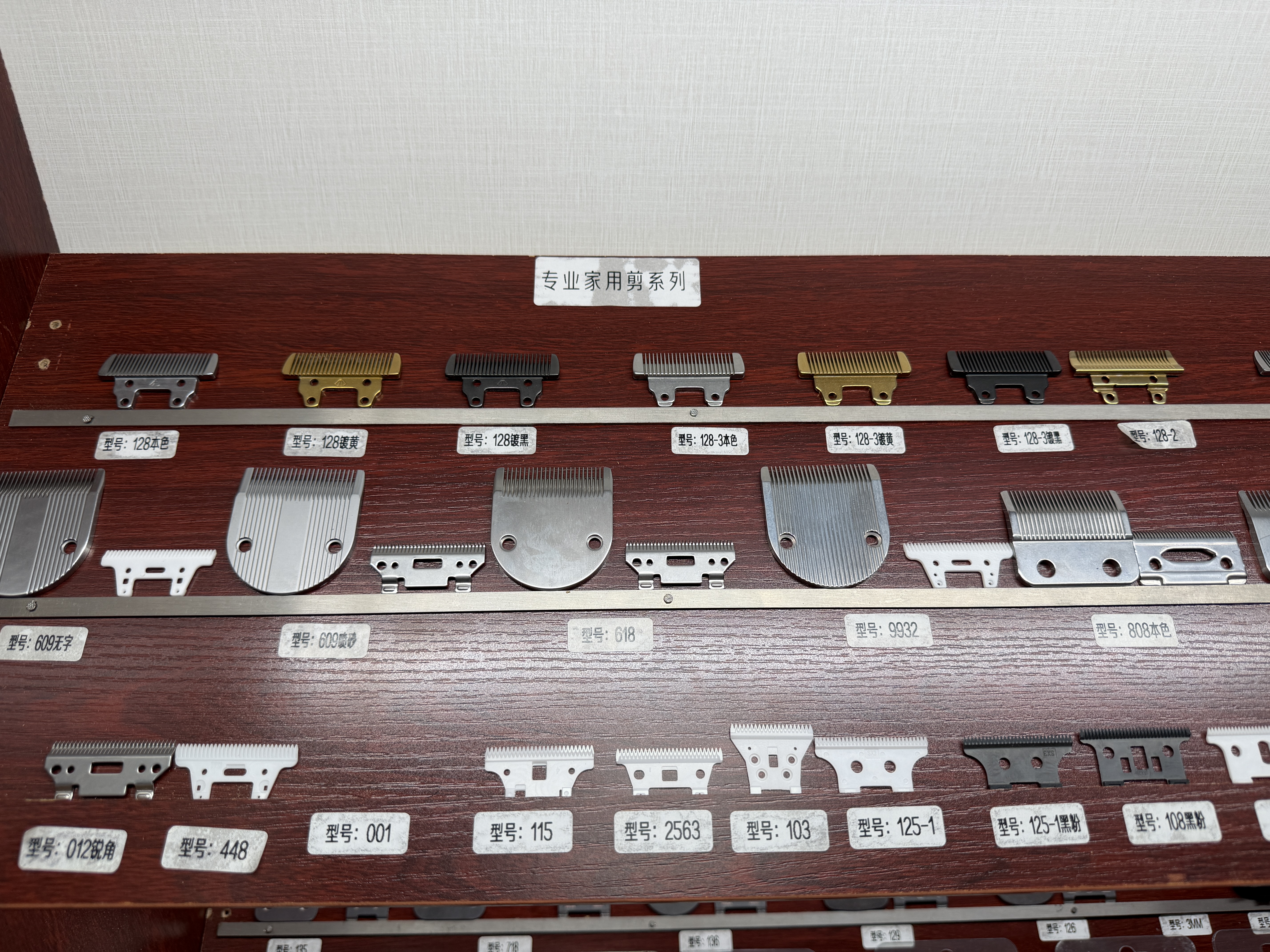
All-steel: Both the stationary comb and moving cutter are made from hardened steel. This is the traditional, most affordable option. Steel blades are durable, impact-resistant, and widely available. SUMTHIN steel A5 blades are produced via MIM powder metallurgy with a hardness of HRC 60-62 — significantly harder than stamped blades (HRC 54-58).
Ceramic cutter + steel comb: The moving cutter blade is made from zirconia ceramic, while the stationary comb remains steel. Ceramic cutters stay 75% cooler during operation (friction coefficient of 0.3 vs 0.6 for steel-on-steel), last 3-5x longer between sharpenings, and never rust. The downside: ceramic is brittle and can chip if dropped on a hard surface. Ceramic blades cost approximately 40-60% more than all-steel.
Both configurations use the same A5 hinge system — ceramic A5 blades are drop-in replacements for steel blades, and vice versa. For a complete comparison with data from our production testing, see ceramic vs steel clipper blades.
How to Choose the Right A5 Blade
Choosing the right A5 blade comes down to four questions:
- What cutting length do you need? Match the blade number to your target length using the size chart above. If unsure, start with a longer blade (#5F) and go shorter as needed — you can always take off more, but you cannot put hair back.
- Finish-cut or skip-tooth? Use finish-cut (F/FC) for the final pass and any work where smoothness matters. Use skip-tooth for initial clipping through thick, matted, or dirty coats.
- Steel or ceramic? If you groom 5+ dogs per day, ceramic pays for itself through reduced heat issues, fewer blade swaps, and longer edge life. For occasional or home use, steel is more cost-effective and less fragile.
- How many blades do you need? Professional groomers typically keep 3-5 blade sizes in rotation: #10 (for faces, feet, sanitary), #5F or #7F (for body work), #30 or #40 (under guide combs), plus one skip-tooth for matted dogs. Having multiples of your most-used size avoids overheating — swap a hot blade for a cool one mid-groom.
A5 Blade Maintenance Essentials
A5 blades are an investment — proper maintenance extends their working life by 2-3x:
- Oil before and after every use. Apply 3-4 drops of blade oil to the teeth and side rails. This reduces friction, heat, and corrosion. See our clipper blade oil guide for the full technique.
- Clean between animals. Brush hair from teeth, spray with blade coolant/disinfectant. This takes 10 seconds and dramatically extends blade life.
- Store dry and oiled. After the last groom of the day, brush clean, oil, and store blades in a dry case. Never store blades loose in a drawer where they can bang against each other — this chips teeth and damages cutting edges.
- Sharpen on schedule. Professional groomers using blades daily should sharpen every 4-8 weeks depending on volume. Our MIM blades (HRC 60-62) hold their edge 40-50% longer than standard stamped blades. See how to sharpen clipper blades.
- Replace when teeth are damaged. Chipped, broken, or heavily corroded teeth cannot be sharpened back to safe operation. After 4-5 sharpenings, the teeth height is too reduced for effective cutting — time for a new blade.
For the full maintenance protocol, see our blade cleaning and maintenance guide.