
How to Sharpen Dog Grooming Blades: Step-by-Step for Groomers (2026)
Sharpen dog clipper blades flat, not at an angle. Step-by-step 400/800-grit method, service costs ($5-8/blade), how many times a blade can be sharpened, ceramic warnings, and horse blade differences. From a blade manufacturer.
Quick answer: Dog clipper blades are sharpened flat, not on an angle. The cutting surface of both the top comb and the bottom cutter is ground flat against a 400-grit then 800-grit abrasive plate, removing 0.02-0.05mm of steel per service. A stamped stainless blade survives 5-8 sharpenings before the teeth get too short; a sintered MIM blade like ours holds 10-15 because the tooth body is thicker. Professional sharpening costs $5-8 per blade in the US; a replacement A5 blade costs $18-35 retail. Ceramic blades should never be sharpened at home.
We manufacture detachable pet grooming blades in Haining, China, and we get the same three questions from groomers every week: is this blade dull or dirty, can I fix it myself, and how many times can it be sharpened before I throw it away. This guide answers all three from the factory floor — including the tooth-height numbers most sharpening guides never mention.
First: Is Your Blade Actually Dull?
Around half the blades sent to sharpening services do not need sharpening. They need cleaning, oiling, or a tension spring adjustment. Sharpening a blade that is merely gummed up throws away tooth height you can never get back.
Run this check before you touch an abrasive plate. Pull the blade, brush the hair out of the teeth, drop it in blade wash for 30 seconds, dry it, oil the rails, and re-test on a real dog. If it cuts clean now, the blade was dirty, not dull.
| Symptom | Most likely cause | Fix |
|---|---|---|
| Blade pulls and grabs coat | Hair packed under the cutter, or dull teeth | Clean and oil first; sharpen only if it still pulls |
| Leaves tracks / uneven lines | Blade misaligned or a chipped tooth | Realign the blade; replace if a tooth is broken |
| Blade gets hot in under 5 minutes | Friction from dull edges or dry rails | Oil; if heat returns fast, sharpen |
| Cuts wet coat but not dry | Edge rounded, still just barely cutting | Sharpen now |
| Visible rust film on the cutting face | Stored wet after cleaning | De-rust, then sharpen if pitting remains |
| Motor bogs down / sounds strained | Over-tightened tension spring | Reset spring tension |
Why Dog Blades Dull Faster Than Barber Blades
A barber blade cuts clean, washed human hair. A grooming blade cuts coat that carries sand, road salt, dried mud, and dander — abrasives that are harder than the steel. In our own accelerated wear testing, a 420 stainless A5 blade run on sand-contaminated coat loses acceptable edge geometry in roughly 30-40% of the operating hours it achieves on clean coat.
That is why grooming shops sharpen on a schedule rather than by feel. The working rule most professional shops use:
- Full-time grooming salon: sharpen every 6-8 weeks per blade in rotation
- Mobile groomer (higher sand and dirt load): every 4-6 weeks
- Home / hobby use (1-2 dogs): once every 12-18 months
- Livestock and horse work: every 8-12 animals for cattle, more often on dusty ranch coats
Method 1: Flat Abrasive Plate (What Professional Sharpeners Use)
This is the correct method, and it is the one that surprises people: dog clipper blades have no bevel to maintain. Both the comb (top) and cutter (bottom) are hollow-ground at the factory so that only the outer edges of the flat face contact the plate. You are restoring that flat face, not filing an angle.
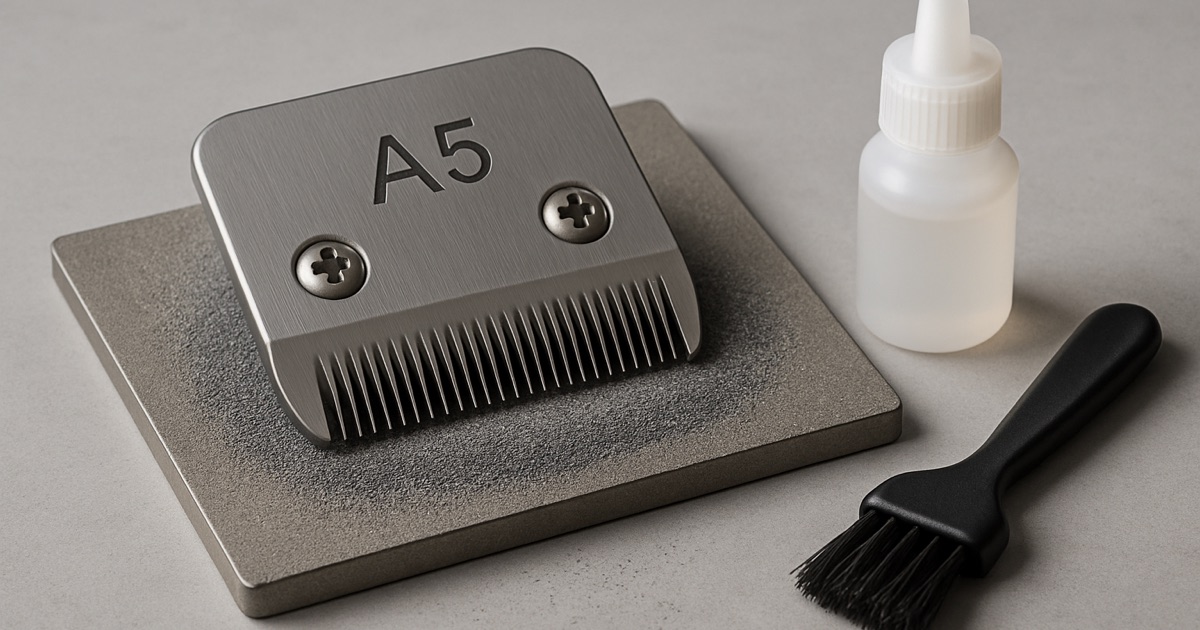
What you need: a flat 8-inch diamond or aluminium-oxide sharpening plate in 400 grit and 800 grit, a magnetic blade holder (or a strong magnet), blade wash, clipper oil, and a small brass brush. Budget kits run $60-140; a proper hone-and-plate setup used by sharpening services runs $400-1,200.
Step by step
- Disassemble. Remove the screws holding the cutter to the comb. Note the tension spring orientation with a photo — reassembling it backwards is the single most common DIY mistake.
- Degrease both parts. Soak 30-60 seconds in blade wash, brush the teeth, dry completely. Any residual oil clogs the abrasive and glazes the plate.
- Mount on the magnet. Flat cutting face down against the plate. The magnet holds the part flat so you are not pressing unevenly with a finger.
- 400-grit pass. Move the part in a figure-eight or slow circular pattern for 8-12 passes with light pressure — the weight of the magnet holder plus a few hundred grams, no more. You are removing roughly 0.01-0.03mm.
- Inspect. The face should show a uniform matte scratch pattern across every tooth tip. Bright spots mean that tooth is not making contact — the part is warped or you are pressing on one end.
- 800-grit finish pass. 6-10 passes. This is what makes the blade cut quietly instead of chewing.
- Deburr. Wipe both parts across a clean sheet of copy paper or a leather strop to knock off the wire edge. Skipping this step is why some home-sharpened blades snag on the first dog.
- Reassemble and set alignment. The cutter teeth must sit 1.5-2.0mm back from the comb tips on an A5 blade. Too far forward and the blade will cut skin.
- Oil and test. Three drops on the rails, one on each end of the cutter. Run the clipper for 20 seconds, wipe, then test on coat.
Method 2: Whetstone (Acceptable for a Field Fix)
The whetstone method most consumer guides describe — a 3000/4000-grit water stone followed by an 8000-grit polishing stone — will restore a lightly dulled blade. It works because a water stone is flat enough to serve as a crude lapping plate.
Its limitation is flatness tolerance. A worn water stone dishes in the middle, and a dished stone rounds the tooth tips instead of flattening them. If you use this method, flatten the stone on a lapping plate first, and check your work: lay the finished part on a known-flat surface and look for light under the teeth.
Use the whetstone method for a mid-week rescue. Use the flat-plate method, or a service, for real restoration. Our full step-by-step home sharpening guide covers the stone technique in detail for barber blades.
Method 3: Professional Sharpening Service
US sharpening services charge $5-8 per A5 blade, $7-12 for wide blades, and $10-18 for ceramic (where they will service it at all). Most run a 3-7 day turnaround plus shipping, and many attend grooming trade shows offering same-day service.
For a working salon with 20 blades in rotation, that is $100-160 per sharpening cycle against $360-700 to replace the same blades. The service wins on economics until the teeth run out of height.
| Option | Cost per blade | Turnaround | Best for |
|---|---|---|---|
| DIY flat plate kit | $60-140 setup, then ~$0.30/blade | 20 min | Shops with 10+ blades, willing to learn |
| Whetstone | $25-60 setup | 15 min | Emergency touch-up only |
| Mail-in service | $5-8 + shipping | 3-7 days | Most groomers, most of the time |
| Replace with new blade | $18-35 retail / $6-14 wholesale | Immediate | Blades past 5-8 sharpenings, chipped teeth, warped combs |
For a deeper cost breakdown including break-even math for multi-groomer shops, see our sharpening cost analysis.
How Many Times Can a Blade Be Sharpened? (The Number Nobody Publishes)
This is a manufacturing question, and it comes down to tooth height. Every sharpening removes 0.02-0.05mm from the cutting face. Once total stock removal reaches roughly 0.3-0.5mm, the tooth tips have receded far enough that the cutter no longer overlaps the comb correctly and the blade cuts longer than its marked size — a #10 starts behaving like a #9.
| Blade construction | Usable stock | Realistic sharpenings | Notes |
|---|---|---|---|
| Stamped 420 stainless | ~0.3mm | 5-8 | Most budget A5 blades |
| Stamped 440C, hardened | ~0.35mm | 6-10 | Holds edge longer between services |
| MIM / sintered (HRC 60-62) | ~0.5mm | 10-15 | Thicker tooth body from net-shape moulding |
| Ceramic (zirconia) cutter | n/a | Service only, 2-4 | Requires diamond abrasive; chips if mishandled |
The MIM advantage is not marketing. Because metal injection moulding forms the tooth as a net shape rather than stamping and grinding it from sheet, we can leave more material below the cutting face without changing the blade's external dimensions. That extra 0.15-0.2mm of stock is what buys the additional sharpening cycles.
Ceramic Blades: Do Not Sharpen These at Home
Zirconia ceramic cutters run about 8.5 on the Mohs scale. A steel or standard aluminium-oxide abrasive will not cut them — it will skate, then chip the tooth tips. Ceramic requires a diamond-charged plate and a much lighter touch.
The honest answer we give customers: ceramic blades stay sharp roughly 4-5x longer than steel and run about 75% cooler, which is why grooming salons buy them. But when they finally dull, send them to a service that explicitly lists ceramic capability, or replace them. Attempting a home sharpening on ceramic usually ends with a chipped cutter and a blade that cuts tracks.
More on the trade-off in our ceramic blades for pet grooming guide.
Sharpening Horse, Cattle and Sheep Blades
Livestock blades are a different geometry and a different job. Horse and cattle clipper blades run wider, cut coarser hair, and are usually a two-piece comb-and-cutter set with a much more pronounced hollow grind.

Three differences that matter:
- The hollow must be preserved. Shearing combs and cutters are ground concave so only the leading edge contacts. Sharpening them dead flat on a plate destroys the geometry. Shearers use a rotating grinding disc with a papered face that reproduces the hollow.
- Sharpening frequency is far higher. A shearing cutter may be swapped every 1-3 sheep and reground the same day. Sand and lanolin are brutal on the edge.
- Horse blades (Lister, Heiniger, Oster A5-compatible) sit in between. A5-pattern horse blades sharpen flat like dog blades; dedicated shearing-head blades do not. Check which system you have before you start — our horse and equine blade guide maps the compatibility.
If you shear commercially, buy a purpose-built grinder. If you clip a handful of horses per season with A5-pattern blades, the flat-plate method in this article is correct, and a mail-in service is cheaper than the equipment.
Make Sharpenings Last Longer
The cheapest sharpening is the one you postpone. Five habits that measurably extend the interval:
- Bathe and dry before clipping. Clipping a dirty coat is the single biggest driver of blade wear. A rough-in on a dirty dog should be done with a blade you have already retired to that duty.
- Oil every 10-15 minutes of run time, not just at the end of the day. Three drops across the cutter teeth and one on each rail. See our blade oil guide for what to use and what to avoid.
- Brush hair out between dogs. Packed hair under the cutter forces the teeth apart and accelerates wear on the contact faces.
- Rotate blades by size. Running one #10 all day guarantees you sharpen it every six weeks. Rotating three #10 blades triples the interval on each.
- Do not over-tension the spring. Excess tension increases contact pressure between comb and cutter, which grinds both faces during normal operation.
When to Stop Sharpening and Replace
Replace the blade rather than sharpening if any of the following is true:
- A tooth is chipped, bent, or missing — sharpening cannot restore a missing tooth
- The blade now cuts noticeably longer than its marked size (tooth height exhausted)
- The comb is warped: laid on glass, you can see light under the middle or the ends
- Rust pitting is visible on the cutting face after de-rusting
- Total sharpenings exceed the counts in the table above
For salons, the practical move is to buy replacement blades wholesale rather than at retail. Retail A5 blades run $18-35; direct-from-factory wholesale for the same size lands at $6-14 depending on material, volume, and whether you want your own branding. We ship OEM and private-label blades from 500 pieces per SKU.
Related Guides
- Dog Grooming Blade Size Chart: All Sizes in mm with Breed Recommendations
- Best Dog Grooming Clipper Blades: Sizes, Materials and Brands
- Clipper Blade Not Cutting? 9 Causes and Fixes
- How to Clean and Maintain Clipper Blades
- Why Do Clipper Blades Get Hot?
Need Blades Instead of Sharpening?
SUMTHIN has manufactured clipper and grooming blades in Haining, Zhejiang for over 30 years, supplying brands in 45+ countries. We produce A5 detachable, ceramic, wide grooming, and livestock blades using MIM powder metallurgy at HRC 60-62. MOQ starts at 500 pieces per SKU with logo engraving, and reorders ship in 15-30 days.
Request a quote or blade samples and tell us your sizes and volumes — we will send specs, hardness reports, and pricing.
Frequently Asked Questions
Can you sharpen dog clipper blades at home?
Yes, if you use a flat abrasive plate in 400 then 800 grit and sharpen the cutting faces flat rather than at an angle. Disassemble the blade, degrease it, hold each part flat against the plate with a magnet, make 8-12 light passes at 400 grit and 6-10 at 800 grit, deburr, then reassemble with the cutter teeth set 1.5-2.0mm back from the comb tips. Do not attempt this on ceramic blades.
What angle do you sharpen dog clipper blades at?
Zero degrees — flat. This is the most common misunderstanding. Clipper blade teeth are hollow-ground at the factory so only the outer edge of the flat face contacts the abrasive. Introducing a bevel ruins the shear action between comb and cutter and the blade will pull instead of cut.
How often should grooming blades be sharpened?
A full-time salon blade in rotation typically needs sharpening every 6-8 weeks; a mobile groomer working dirtier coats every 4-6 weeks; a home user with one or two dogs every 12-18 months. Frequency depends on cutting hours and coat contamination, not calendar age.
How much does it cost to sharpen dog clipper blades?
US sharpening services charge $5-8 per standard A5 blade, $7-12 for wide blades, and $10-18 for ceramic. Turnaround is usually 3-7 days plus shipping. A DIY flat-plate kit costs $60-140 up front and pays for itself at roughly 15-20 blades.
How many times can a clipper blade be sharpened before replacing it?
A stamped 420 stainless blade takes 5-8 sharpenings, 440C takes 6-10, and a sintered MIM blade takes 10-15 because the tooth body carries more stock. Each service removes 0.02-0.05mm; once total removal passes roughly 0.3-0.5mm the blade cuts longer than its marked size and should be replaced.
Can ceramic dog clipper blades be sharpened?
Only by a service with diamond-charged equipment, and only 2-4 times. Zirconia ceramic is about 8.5 on the Mohs scale, so standard steel and aluminium-oxide abrasives will not cut it and will chip the tooth tips instead. Most groomers replace ceramic cutters rather than sharpen them.
How do you sharpen horse and sheep shearing blades?
Differently from dog blades. Shearing combs and cutters are hollow-ground concave and must be reground on a rotating disc grinder that reproduces that hollow — flattening them on a plate destroys the geometry. A5-pattern horse blades, however, sharpen flat exactly like dog blades. Identify which system your blade uses before starting.