
Best Clipper Blades for Thick Hair: Top Picks for Barbers & Groomers
Which clipper blades handle thick, coarse, or curly hair best? Blade material, tooth geometry, and motor pairing recommendations from a manufacturer who tests blades on every hair type.
Thick and coarse hair is the ultimate stress test for a clipper blade. Fine hair yields to almost any edge; coarse, curly, or wiry hair fights back. It demands more cutting force per strand, generates more heat through friction, and dulls blades faster. If your blade pulls, jams, or overheats on thick hair, you do not have a technique problem — you have a blade specification problem. This guide explains exactly which blade characteristics handle thick hair, which ones fail, and why.
As a manufacturer producing blades for barber, grooming, and livestock markets — all of which involve cutting through challenging hair and coat types — we test every blade model on a range of hair thicknesses from fine human hair (50 micrometers) through coarse horse mane (200+ micrometers). Here is what the data shows.
Why Thick Hair Is Hard to Cut: The Physics
Hair cutting is a shearing operation. The force required to shear a single strand scales with the cross-sectional area of the hair. Coarse hair has 3–4x the cross-sectional area of fine hair, which means:
- 3–4x the cutting force per strand. Multiply by hundreds of strands entering the blade per second, and the total load on the motor and blade is dramatically higher.
- Higher friction = more heat. Coarse hair creates more contact friction as it feeds through the teeth. Blade temperature rises 40–60% faster on thick hair than fine hair under identical conditions.
- Faster edge dulling. The cutting edge experiences 3–4x the impact force per strand, causing microscopic edge rounding (dulling) to accelerate proportionally.
- Higher risk of feeding jams. Thick hair is less flexible and does not bend easily into the tooth gaps. If tooth spacing is too narrow, hair bunches at the intake and stalls the cutter.
Blade Characteristics That Handle Thick Hair
1. Tooth Spacing (Most Important Factor)
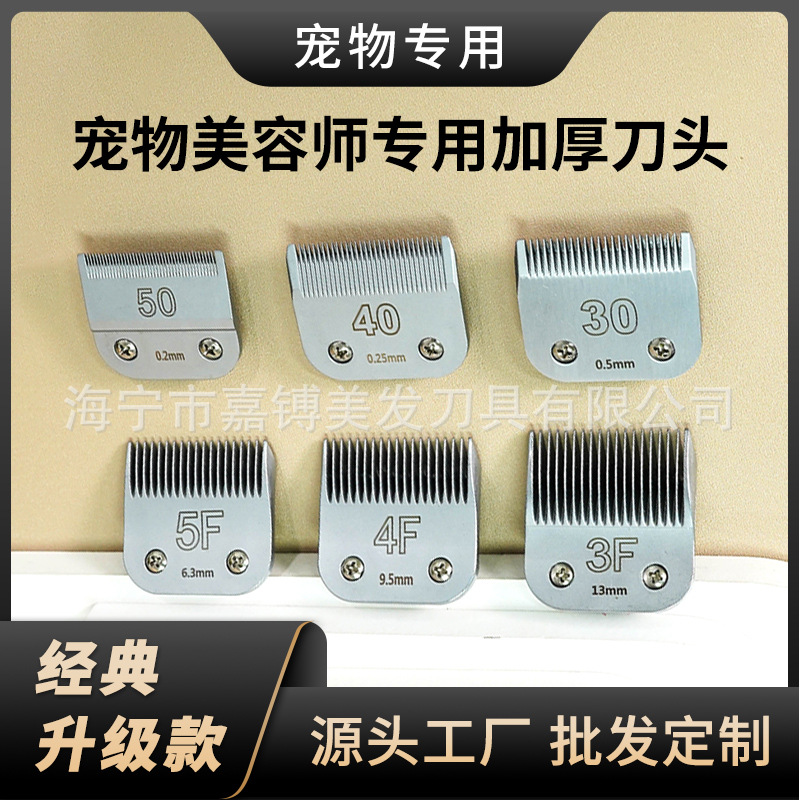
Wider tooth spacing allows more hair to enter the cutting zone without jamming. For thick human hair, standard taper blades with 30–36 teeth work well. For very thick animal coats, skip-tooth blades (A5 blades without the "F" designation) have every other tooth removed, creating gaps wide enough for even matted coat to feed through.
| Blade Type | Tooth Count | Tooth Gap | Thick Hair Performance |
|---|---|---|---|
| Skip-tooth A5 (#3, #4, #5, #7) | ~17 teeth | ~2.5mm | Excellent — designed for thick/matted coats |
| Standard taper (Wahl/Andis) | 30–36 teeth | ~1.2mm | Good — handles most thick human hair |
| Finish-cut A5 (#5F, #7F, etc.) | ~34 teeth | ~1.0mm | Fair — may jam on very thick/matted hair |
| Fine finishing blades (#10, #30, #40) | ~46 teeth | ~0.5mm | Poor — jams easily, for pre-cleaned thin hair only |
2. Blade Material and Hardness
Harder blades resist the accelerated dulling caused by coarse hair. The hardness-to-performance relationship is direct and measurable:
- HRC 48–52 (stamped carbon steel): Dulls 2x faster on thick hair. Acceptable for light home use, not for professional volume on coarse hair types.
- HRC 56–58 (stamped stainless 440A): Adequate for professional barbers who sharpen regularly. Industry standard.
- HRC 60–62 (MIM 440C stainless): Best steel option for thick hair. Edge retention is 2x better than HRC 52 blades. This is what SUMTHIN produces.
- HRC 85+ equivalent (ceramic zirconia): Maximum edge retention and lowest heat generation. Ideal for high-volume shops cutting predominantly thick hair. Cannot be resharpened — replace when dull.
3. Cutter-to-Comb Clearance
The space between the cutter and comb must be adequate for thick hair to pass through the shearing zone. Blades manufactured with tight clearances (common in cheap aftermarket blades) jam more easily on thick hair because hair cannot feed through the narrow gap between the sliding surfaces. Quality blades maintain a precision clearance of 0.05–0.10mm — tight enough for clean cutting but open enough for consistent feeding.
4. Motor Pairing Matters
The best blade in the world will fail on thick hair if the motor cannot deliver enough power. The blade does not generate its own cutting force — the motor does.
| Motor Type | SPM (Strokes/Min) | Torque | Thick Hair Suitability |
|---|---|---|---|
| Magnetic (pivot motor) | ~7,200 | Low | Fair — bogs down on very thick hair |
| Pivot motor (enhanced) | ~6,000 | Medium | Good — better torque, slightly slower |
| Rotary motor | ~3,500 | High | Excellent — maintains speed under load |
| Brushless DC motor | ~5,500–7,000 | Very High | Best — high speed + high torque |
Rotary and brushless DC motors maintain their speed when hair loads the blade, while magnetic motors slow down under load. For barbers cutting predominantly thick, coarse hair (Type 4 curly/coily patterns, thick Asian hair, etc.), a rotary or brushless motor paired with a high-hardness blade is the optimal combination.
Best Blade Recommendations by Hair Type
| Hair Type | Recommended Blade | Recommended Motor | Key Consideration |
|---|---|---|---|
| Type 4 Coily/Kinky | Stagger-tooth taper or ceramic cutter | Rotary or BLDC | Maximum edge hardness to prevent snagging on tight curls |
| Thick Straight (Asian) | Standard taper, HRC 60+ | Rotary or BLDC | High cutting force needed — individual strands are strong |
| Thick Wavy (Mediterranean) | Standard taper, oil frequently | Pivot or rotary | Hair volume creates heat — oil every 2 clients |
| Double-Coat Dog Breeds | Skip-tooth A5 (#4, #5, #7) | 2-speed rotary | Undercoat feeds in with guard coat — needs wide teeth |
| Horse Body Clipping | #3F or #3 A5 blade | Heavy-duty rotary | Extended sessions — ceramic cutter recommended to reduce heat |
Common Mistakes When Cutting Thick Hair
- Using a fine blade first: Never use a #10 or higher on thick, unclipped hair. Start with a coarser blade or guard, then work shorter.
- Skipping oil: Thick hair generates significantly more heat. Oil every 2 clients instead of every 3.
- Forcing the blade through: If the blade stalls or pulls, slow your feed rate (move the clipper more slowly through the hair). Forcing creates uneven cuts and damages the edge.
- Blaming the blade when the motor is weak: A magnetic motor clipper with a perfect blade will still struggle on thick hair. Test the same blade on a rotary clipper before concluding it is dull.
- Not washing hair first: Product buildup (gel, pomade, wax) on thick hair multiplies friction and heat. A quick wash before cutting extends blade life significantly.
Related Guides
- Clipper Blade Steel Grades — Full comparison of 420, 440A, 440C, carbon steel, and ceramic.
- Ceramic vs Steel Clipper Blades — Heat and edge life data from lab testing.
- Dog Grooming Blade Size Chart — All sizes with breed recommendations.
- Professional Barber Clipper Guide — Motor types and blade matching.